Archive for the ‘Uncategorized’ Category
Hidy Ho Fine Neighbors,
Hope all has been going swimmingly for all of you folks. I’ve been staying busy, writing, speaking, picture taking, film-making, tying, and running my pheasant dogs. Things are good.
As I mentioned, I’ve been doing a fair amount of speaking, and at this time I’ve about a dozen gigs scheduled this year. I expect a few more to trickle in. My main presentation deals with mastering technical water. The talk revolves around catching big, selective tailwater trout. Trout that are highly pressured and more than a little “experienced”.
A small part of the presentation deals with how to attack technical water you’ve rarely or never fished. Without going into technique at this time, and assuming that the technique used is fundamentally sound, I talk about 3 aspects that go into selecting the proper flies to throw. The 3 aspects are historical data, seasonal data, and conditional data. Let’s break’em down.
Historical data is data that can be gathered accurately from several sources. This data is about which bugs are typically active or hatching historically, or the same time every year. Notice I said “active or hatching” That’s critical, and we’ll hit on that in more detail a bit later. How do you acquire historical data? There are several good sources. One good place to visit is your state’s wildlife organization. With a bit of digging you can find some good info there. Also, join an organization, like TU, or send them a question if you’re out of state. Calling a river specific fly shop is always a good idea to find out which bugs are prevalent at certain times. There are also river specific blogs, river reports, and fly fishing forums you can join in on. Historical data is fairly simple to find.
Seasonal data is basically taking historical data to the next level. I look at seasonal data as “What’s going on with the bugs at this time?” You may have a good handle on which bugs, hatch when historically, but seasonal data further refines the information. For example, on the South Platte this winter we have been seeing about a size 22 midge. Historically, we will begin to see a larger midge come into the picture soon. It’s a crap shoot when it will start to pop in earnest, but I know seasonally, it will come off. The “season” or seasonal factors will determine the hatch. Factors such as unusual cold snaps, non-historical flows and water temps, and even previous factors can put things off or ramp them up seasonally. Maybe that low water we had last summer killed off certain nymphs. That’s seasonal data.
To take advantage of seasonal data, again ask your local shop what’s going on, and look to several sources that I mentioned earlier. Back to the South Platte. I can observe the small midge coming off during the day, and I know historically the larger midge will soon start to hatch, so I will set-up my rig to capture seasonal data by incorporating a larger midge along with the small midge to prepare for the “active” large midge nymphs. Look at seasonal data as the transitions between the main hatches. Prepare for the caddis as you fish Blue Wings. Prepare for PMD’s as you fish with Blue Wings. You get the idea. It’s another way to stay ahead of the hatch, seasonally.
The last bit of data is gathered on the river the day you put your boots in the drink. Conditional data is just that, what’s it like today and what bugs are hatching?

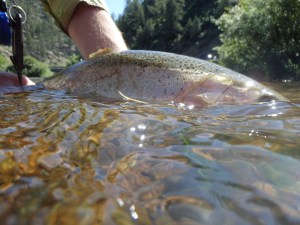
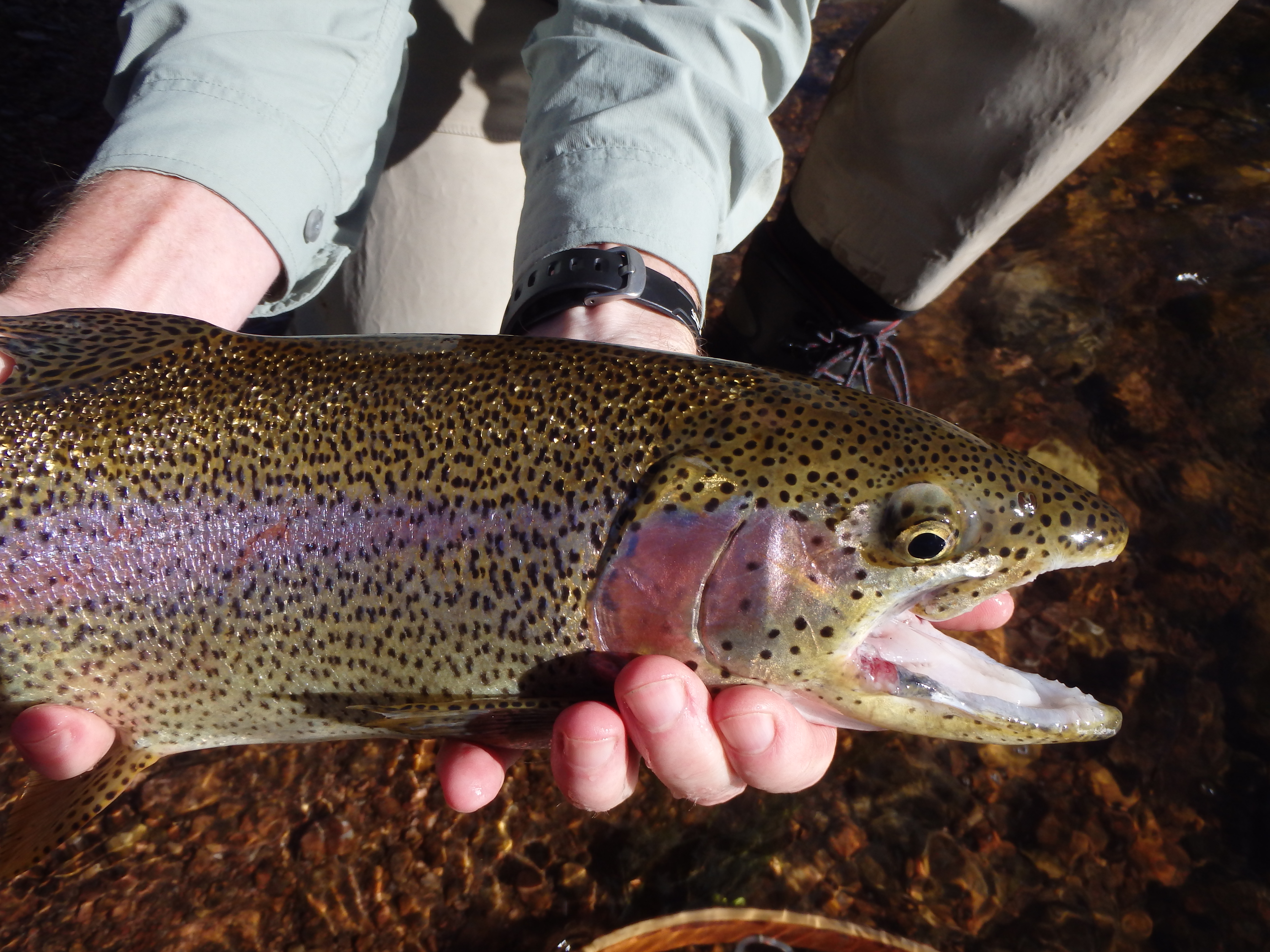
This fish pictured fell prey to a Chocolate Thunder, a Blue Wing emerger. This was a “conditional catch” in that, the day was overcast, and the Blue Wings really came off more than a sunny cloudless day. The hatch was prolific, and lasted longer than normal, allowing the fish to get really dialed in to feeding on emergers. Conditionally, it was a no-brainer.
So, look at weather conditions to give you valuable clues to bug activity. Is it cold, hot, windy? Is a front coming in, moving away? How about water conditions? Murky or off-color? Low or high? How about angling pressure? These are all observable factors that come into play. In The Fly Fishers Playbook, I have gone to great lengths to try to explain how to fly fish conditionally. It’s that important!
When you combine historical data, seasonal data, and current conditions toward fly selections you are more than ahead of the game. It’s fairly simple and goes a long way toward fly fishing success. So, the next time you get ready to fly fish a river, go armed with proper data, and combine that with the days’ conditions so you don’t have to stand knee deep in the river scratching your head over your flybox.
Thank you for following, and FEAR NO WATER! Duane

Hidy Ho Neighbors!
I had an absolute blast at the Fly Fishing Show. Presentations were packed, met a bunch of super people, and sold some books. My presentation was centered around mastering technical water and one of the rigs I discussed is the “Skinny Rig”. I refer to it as that because it has no weight, and is designed to be fished in skinny/shallow water, or at a skinny depth just below the surface. It’s great for picking off fish in shallow holds or for catching fish feeding on emergers, duns, spents, or pupa just below the surface, in the film, or on top. I mentioned at the show for folks to come to the blog and search thru the archives for the original skinny rig explanation. That proved to be a pain, so I am going to re-post about it.
The skinny rig is nothing more than giving you the opportunity to put your flies exactly where the fish are feeding. Once you determine what they are feeding on, and where in the column they are feeding, half the battle is won. Let’s say that you see fish feeding slightly below the surface, with their backs breaking the water, but their heads are not. Maybe there’s a Blue Wing hatch occurring simultaneously. Bingo, they are probably eating the emergent phase of the BW. This is where the skinny rigs shine, and can be used for any emerging or pupating insects.
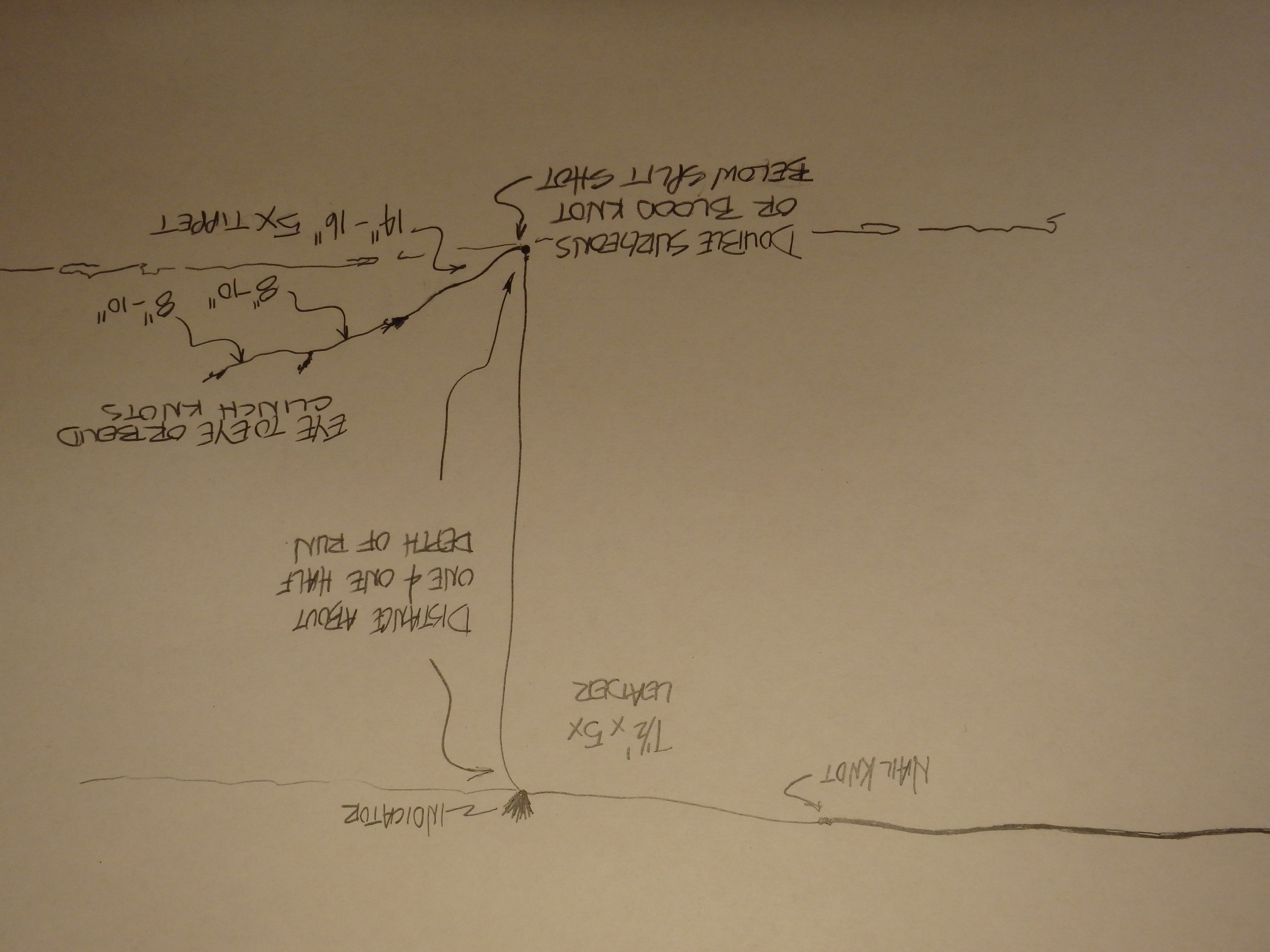
Using my normal nymph rig (pictured), simply move the indicator up the leader so it’s about 5 feet from the first dropper. Take off any and all split shot weight, apply floatant to the San Juan Worm (SJW), and you’re ready to go. If you’re not using an SJW just make sure the fly you have in that position is NOT weighted.
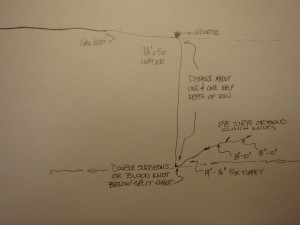
I use monofilament leader in all of my nymph rigs because mono floats better than flourocarbon, and I want something that helps buoyancy of the rig. The tippets are flouro, but that doesn’t seem to hurt the drift because most drifts are only 5 or so feet and the mono is carrying the heavy load. Sliding the indicator away from the flies just helps to ensure you’re not spooking fish with indicator “slap”, and that the fish only see the presented flies.
Once you find feeding fish as I explained, the set-up is critical. Most of the time, you’ll set up slightly downstream of the fish. Occasionally you’ll set up above the fish, but that’s for special occasions when it’s the only way you can get to them. Pick out one feeding fish when possible, and cast accordingly. You’re probably screaming, “According to what!” According to the speed of the water and the depth of the fish. It’s your job to try to place your offering at or above the fishes level. You do that by practicing casting angles, reading water, and reading fish depths and feeding behavior. It’s not as tough as it sounds, but does take practice.
Most drifts are much less that 5′, so once you learn the sink rate of your particular rig, you’re almost there. I have beginners use this method a lot, so it can be perfected quickly,IF, you have a working idea as to how quickly your rig sinks. Experiment.
The “set” on the skinny rig is more of a full “lift” Too rigorous a set, and you’ll snap everything off, especially after nymphing with the same rig for a period of time. I could carry a second rig set-up with a dry-drop rig to use for the same reason, but I’d rather capitalize on the versatility of the nymph rig. Plus, it’s really fun to set on a “swirl” around your fly, or to watch the indicator scream across the river without warning.
Here’s a quick video showing casting angles. Go to: (click on)
Hope this explains the rig. The best way to learn it is to use it, so Fear No Water!
Duane

Hidy Ho Good neighbors,
Just like spring is for love, winter is for improvement. Of course I’m talking about fly fishing, winter is a great time for improving your skills. This winter I’m working on my photography and videoing skills. I have a ways to go, but it’s neat to research, seek out those that have the skills I want to develop, and utilize the cool lighting winter presents. Alan Peak and I went fishing over a month ago, because I needed additional pictures for the upcoming book. It’s easy to see the difference between his photos and mine, but I’m learning.
I really need to learn how to edit my videos. All of my videos are one-shot, no edit jobbies. The ability to edit would greatly enhance the quality. Heck, I just realized the other day while video taping a clip for an upcoming presentation that my camera has a setting that actually mutes out wind and flowing water sounds. Geez.
Speaking of presentations, I am presenting at this years Fly Fishing Show in Denver the 3rd,4th, and 5th of January. I’ll be presenting about mastering technical waters, specifically the South Platte River. Shows are Friday @ 3 room C, Saturday @ 3 room A, and Sunday @ 3 room B. I’ll also be in the Authors Booth signing books Friday @ 5, Saturday @ 4 and Sunday @ 1:30. Hope to see you there!
I’ve been encouraging several fly anglers to work on their streamer fishing skills. I basically began my fly fishing swinging streamers and wet flies. Caught a lot of fish as a kid using those 2 methods. I like nothing more than to work a stream from the middle out, downstream, ripping streamers. Great way to “pre-fish” waters I’ve never been on, and a great way to hook some big fish. Just a simple quarter downstream approach will garner you plenty of action, but you will learn cross-stream, upstream, and downstream techniques too.
You learn to “feel” where the streamer is in the columns and seams and this helps you give or take line. You learn to mend line to sink the streamer, speed it up, impart darting movements, and prepare for the swing stage. I believe really learning to streamer fish will enhance ALL of your fly fishing skills because it’s all about feel and line/rod management.
Shorten up those leaders to about 5 feet, with about a 2x leader diameter tied to the streamer. I use a duncan loop for the knot, because it allows for a bit more streamer movement. In most rivers, I’ll stick with my floating line, but I have used intermediate and full sink lines to swing fish meat. Slow down your casting motion or you could end up wearing a nice streamer. Or you could learn to spey cast and really get into the essence of streamer fishing. You’ll learn very quickly as you pick up a few fish that streamer fly fishing can be explosive. The takes are incredible, like an electric jolt.
Have a Happy New Year, pick something you want to improve, and as always, Fear No Water!
Duane

Baby it’s cold outside. So cold that the Blue Wings are bygone, the PMD’s stopped popping, the Stone flies are stoned, and the Tricos are trippin’. What to do? Well, now’s the time of year to hone your skills on your favorite tailwater. Winter affords you the opportunity to work on skills that you’ve been meaning to get to. I enjoy fly fishing through the winter, here are a few reasons why.
- Less crowds.
- Gin clear, skinny, challenging water.
- Research and Development.
- Simply beautiful.
Although the calendar doesn’t agree, it’s winter for trout and the insects that feed them. Water is cold and the bugs are less prolific, except for one little tiny giant of a bug, the midge. Tiny in stature but a giant in sheer numbers, midges feed trout year round, but are mostly the only game in town during winter months. Trout depend on them as a food source.
Let’s talk water characteristics before we go too deeply into midges. Where I guide, the air temperatures don’t mean much at all compared to water temperatures. When the water hits about 39 degrees, the trout start to feed in my favorite tailwater, the South Platte. Not a bad idea to carry a thermometer, hit water that has sun exposure first, and get used to layering up to stay warm.
Obviously, the river is going to be a lot less crowded. This is important for several reasons, but two come to mind directly. One, it’s a great experience to slow down your fly fishing because you don’t have to bust tail getting from one spot to the next, and you can slow your cadence to match the river, because you’re not constantly looking over your shoulder. Two, there’s a lot less pressure on the fish as well. They will settle into winter holds, and when conditions are ripe, they eat readily. You have a chance to hook a fish of a lifetime.
Winter holds are just that. Places where fish have to migrate to in each section and run to get a crack at the best food, oxygen and shelter. They ALL migrate there. Big, medium, small will inhabit the same winter hold. Look for areas that contain the big three needs, and confirm that by locating fish. I always tell folks to fish 4 seasons, especially on the same river. You will see characteristics that don’t present during the other seasons. You’ll notice new scoured out areas that consistent low flows create, obstructions that aren’t always visible, and you’ll locate prime lies because of gin clear water.
With these river conditions come new challenges in presenting bugs. You may have to drop in tippet size (6X), decrease indicator size or go with yarn, and you get to hone skills throwing small dry flies, or ripping big streamers after bigger fish. Gin clear water helps you locate fish, but presenting without spooking is easier said than done. I always set a winter fly fishing goal I want to work on. Last year was nymphing without an indicator. This winter I’m not sure, but I’m leaning toward working on photography skills. It’s a great challenge.
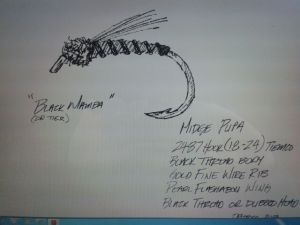
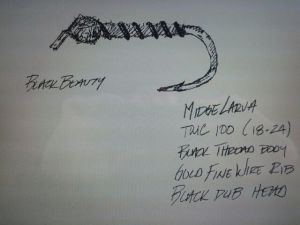
Back to the tiny giant. The midge, or chironomid, is nothing more than a non-biting mosquito. Where legal, I’ll nymph a 3 bug rig under an indicator. This rig consists of an attractor nymph like a scud, egg pattern, or San Juan worm, followed by a midge larva, then a midge pupa pattern spaced as shown in my crude little drawing.
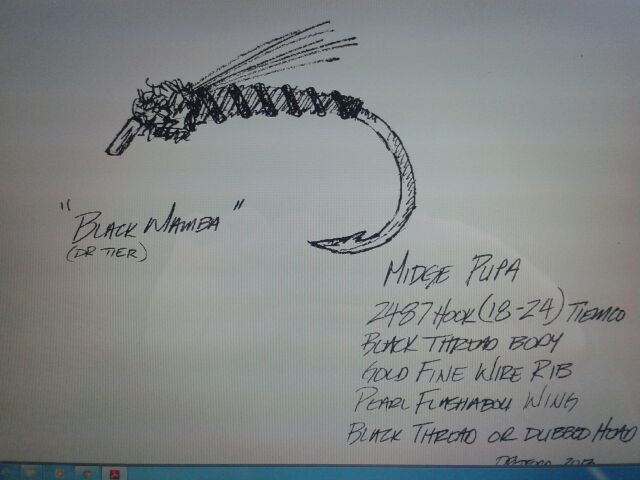
Speaking of crude little drawings, I’ve added a couple of my favorite midge patterns and the recipes to tie them. Remember, the pupa is your last fly in the rig because it is generally highest in the column.
It’s my favorite time of the year to fly fish. Fly fishing in a mild snow fall is an unbelievable experience. Barometric pressures seem to play a bigger role in effecting winter time fishing than other times of the year. I try to fish as a low pressure system approaches, or pressures have been stable for a couple days. You can catch fish any time, but my notes reinforce my approach to fishing and barometric pressures.
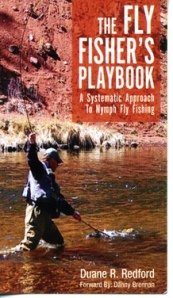
Well folks, Happy Thanksgiving, Happy Winter time fly fishing, and don’t forget to pick up a copy of The Fly Fishers Playbook for your favorite angler for Christmas!
Fear No Water,
Duane
Grip and grin, hero shot, whatever you call it, pictures preserve memories. Maybe not so much of the fish you caught as much as the day itself. I get a kick out of looking back through pictures remembering who I was with, where I was, and just the general tone of the day. Like most of you, I’ve literally thousands of fly fishing pictures. There’s only so much refrigerator space, so most of them end up in some box or on some thumbdrive, never to be seen again. For my latest book work, I have taken hundreds of pictures of which only a select few will make it into the next book. I am no great shakes as a photographer, so I rely on those that are accomplished to lend a hand. However, out on the water, I’m it. Net-man, fly extractor and photographer. Kind of a pressurized position if you ask me. I am certainly not going to take you on a “how-to” in this post, this is more of a celebration of what I get to do with folks from all over the world, and pictures preserve it. Pretty dang cool if you ask me. Here are a few pictures from last year………
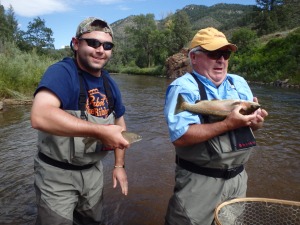
This is what I call the insurance shot. Take a picture like this when folks land their first fish on a fly rod. After this shot we attempt to have the client hold the fish if time and fish stress permit. Nonetheless, picture preserved. 
Here’s the old” guide in the shot to help hold big fish” (also an insurance shot). 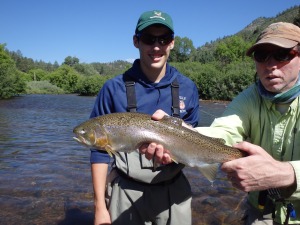 There are also “signature shots”. This is one of my best clients and good friend John. I have dozens of fish pics with him. They all look like this. Not sure I even know what he looks like…..
 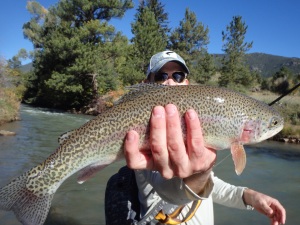 The next 2 shots are my favorite kind. “Fish shots”. Just taken to honor a beautiful fish. Left to right, “the cradle” and “the spoon”.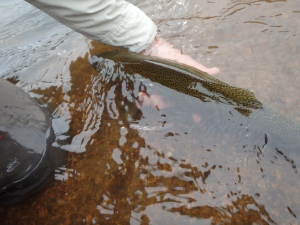
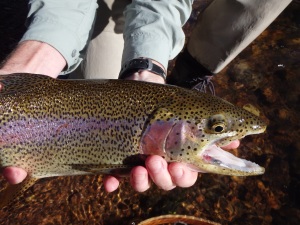
All shots aren’t hero shots, some fall short. Some are my fault, some the clients fault, most are just caused by the fish not following the script.
Here are a few….oops
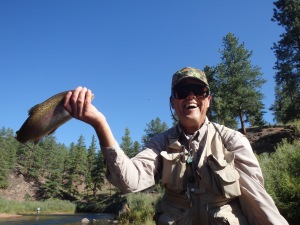
Like I said, i’m not the best photographer, but please remember to wet your hands before handling fish, pinch barbs, get them back to the water quickly, and keep em off rocks, grass, dirt, and snow. Watch them swim away folks.
Thanks for following along. Enjoyed it.
Fear No Water!
Duane
Hidy Ho Good Neighbors!
I’m lovin’ me some October. Dawg days of guiding are over, leaves are changing, nip in the air, tricos and fall caddis are popping, and pheasant hunting starts for me and the pooches later this week. Yessir, life is good.
I’m not going to spend much time in the pheasant fields til November, still plenty of fly fishing to do, but I am getting the dogs out for a tune-up soon. Been six months since they cruised the bluffs. In the meantime on the river, the fishing’s been good. Although a large portion of our watershed suffered from the floods, we were basically spared from damage. Being so close to the dam and the fact we didn’t get half of the rain others got, we made it out with some higher than normal flows and off-color water.
Of course, I guided through it, we all did. Whenever I run into conditions such as these (high off color water), I employ a strategy that has worked for me over the years. Quite simply, I will run bigger, darker bugs, and approach the river “blindly” with a grid approach. I’ve talked about the grid before, but this time I posted a video at http://youtu.be/r1vLfha4vTM , so you can get an idea of what I mean.
As for the bugs, I throw basically what the river offers, which in this case was bigger dislodged bugs like Stone Fly nymphs, worms, Crane Fly nymphs and leeches. All dead drifted under an indicator. My theory is the darker the water, the darker and bigger the bugs. I will also throw truly fluorescent colors, not just bright colors, but fluorescent. A size 16 black pheasant tail was the bug of choice during those conditions with the red San Juan Worm a close second.
Get the right speed and depth, run bigger darker bugs, and pick the runs apart systematically. Makes for productive off color fishing. As a side note, be careful when wading in conditions such as these. If you can’t see your feet, and aren’t familiar with the run, not a good idea to get too deep.
Thanks for tuning in, and Fear No Water!
Duane
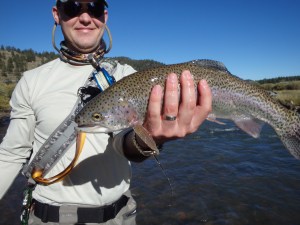 My boy Johnny with a super fish!
Hidy Ho Good Neighbors,
Been a while since my last post, but glad to get a minute to slap some words down. T’was a great summer (I know it’s not officially over), caught a bunch of fish, met some super people, worked nearly everyday, remodeled 2 bathrooms in my house, AND got the house up for sale. Pretty productive.
The Fly Fishers Playbook revision is going well. The addition of around 10,000 words is fairly easy, it’s the pictures and illustrations that are proving difficult. Hopefully, I can find some time to fish on my own to get more pictures. Should be done in a couple months, I hope.
I learn something every time out on a guided trip. The prevailing theme this summer has been set, set, set. I am dedicating a large portion of the chapter in the book about hooking fish to the simple yet all important set. Trying to impress upon folks to set the hook quickly, firmly, yet not too hard as to snap off, isn’t really as easy as it seems.
Most folks new to the game expect to feel the fish eat. Those folks are easy to work with and fix because you can just keep practicing the set over and over again. They will eventually figure it out, but usually remain just a bit slow. That’s also simple to work on by decreasing indicator to weight distance, and finding faster moving water for them to put in some time. The less distance increases their reaction time allowance and faster water will help fish hook themselves.
Intermediate folks are tougher to deal with because they tend to not set because they invision the bugs simply bumping on the bottom. Oft times I will call for a set and the response will be something along the lines of “That was just the bottom”. Drives me crazy. How do they know that? Can’t possibly be able to tell. Those of you that fish under an indicator a lot know that fish will often eat without the indicator even pausing. They eat and spit stuff all day, and our flies are no different. Set on everything.
Advanced nymph fly fishers have learned to set on every bump, twitch and pause. Advanced nymph fishers rarely make it through an entire drift without a set. Advanced nymphers also have learned to set on movement , flashes or subtle changes within four feet of the indicator. Simply put, they set, and don’t question the indicator.
I think that’s how beginners work toward advanced status, fish one rig consistently so you know it very well, and don’t question the indicator. Jeremy Hyatt will ask his clients, “Why are you arguing with the indicator?”. That is the main point, react to the indicator when you can’t see the target fish. If you are sight nymphing and can clearly see the target fish, then try to watch the fish and your flies while keeping the indicator in your peripheral vision. This way you can set on fish movement as it eats, and your indicator becomes a safety valve in case you don’t recognize the eat.
Present and set. That is all it takes. Doesn’t matter to me what it looks like getting to that point, but presentation and the set are crucial to all types of fly fishing. Yea, there are certainly more effective methods of presentation than others, but really, it doesn’t matter how pretty your 20 foot roll cast is. The key is that it gets into the slot you want to drift. As for mending, it’s the same thing. What you can’t lift off the water, you can’t mend, so high stick as often as possible. It isn’t pretty, but it presents the bugs, AND sets you up for an efficient set. Present and set.
That’s plenty for now. Thanks for tuning in again, and I’ll try to get more regular entries as summer wanes.
Fear No Water,
Duane
Some summer pictures……….


Hidy Ho, good neighbors,
Wow, where the heck does the time go? Last post was before fathers’ Day, I look up, and it’s after the 4th. Been working my tail off. Not complaining, mind you, but flat out burnin’ daylight.
Had the distinct pleasure of guiding some great folks from Tomahawk (Middle Fork of the South Platte), to the Dream Stream, to the South Platte below Deckers. Some excellent fish hit the bottom of the net on diverse rigs and diverse bugs.
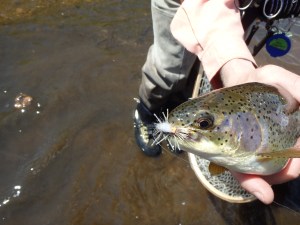
Mustache fish or wearing a disguise…….?
Pale Morning Duns (PMD’s) have been popping pretty well for the last 2 weeks. I love this big mayfly because it’s easy to fish and the fish really dial into the emergent and adult stages. Several fish were hooked on throwing a size 16 dry followed by a Barrs PMD emerger about 18 inches behind it. Just tie some tippet (6x) off of the bend of the big dry and tie the dropper to it.
I watch for classic fish eating behavior to dial in on what phase of what bug their eating. In most cases, early in the hatch, when the PMD’s are really coming off, the fish will be eating the emergers just below the surface. You’ll see their backs roll out of the water as they eat bugs, but rarely will see their mouth out of the water. Telltale sign of emerger eating. When you begin to see their noses or mouths break water, then that means they are beginning to eat the duns. The beauty of the dry-drop rig is simply being able to fish to emerger and dun eating fish. Like I’ve said before, just stay ahead of the hatch by reading the fish, the river, and the bugs.
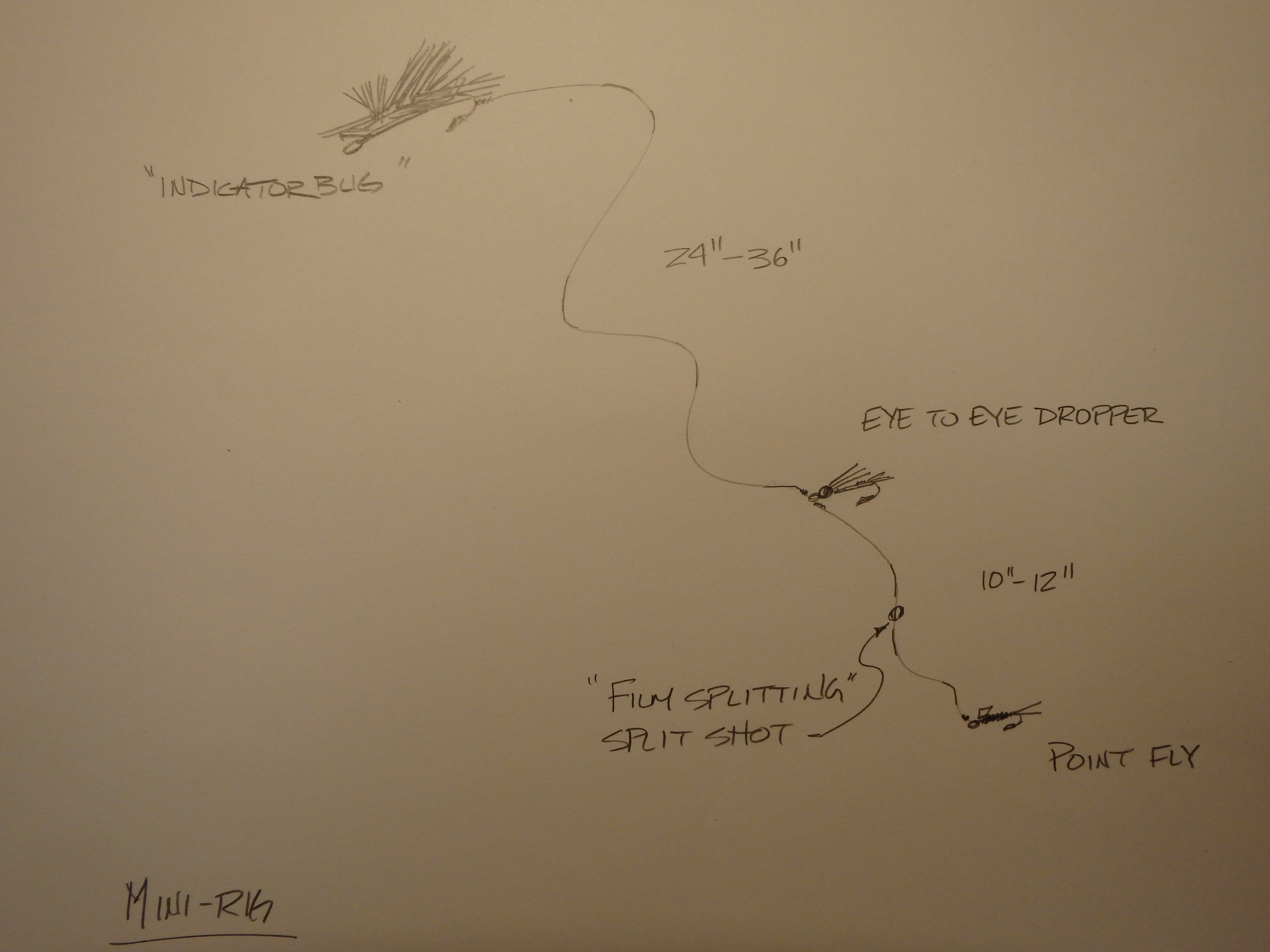
Another rig I have been throwing a bunch recently is the “mini rig”. This rig is so versatile and effective. I will throw this in low to high water conditions and from bank to bank. You can effectively fish different bug species, bug phases, and water columns with one rig. Usually, the top bug is a good floater like Amy’s Ant, Fat Albert, or the Foamulator. I will follow that with a soft hackled pheasant tail, and finally the emerger of choice as a point fly. The fish will readily eat the big dry, but most of the action is sub-surface and the big bug acts as a strike indicator. My favorite rig is an Amy’s Ant, tied to a soft hackled pheasant tail, followed by a brown RSII.

Really starting to get into Trico season. Starting to see big columns of mating Tricos over the river, won’t be long before the fish are really onto the spinner fall. More on this later.
As for other business, I have been producing a new powerpoint presentation, giving presentations, and have inked a deal to begin writing the first revision of The Fly Fishers’ Playbook. It’s gonna have a bunch new information, new pictures and diagrams, and a ton of new text. Probably will have it done by November….I hope. Hopefully, folks will like it as much as the first.
I’ll try not to be absent for so long this next stretch, and until then, Fear No Water!

Duane
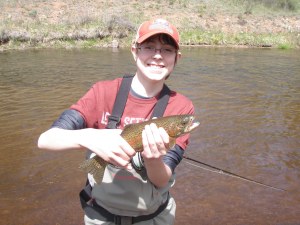
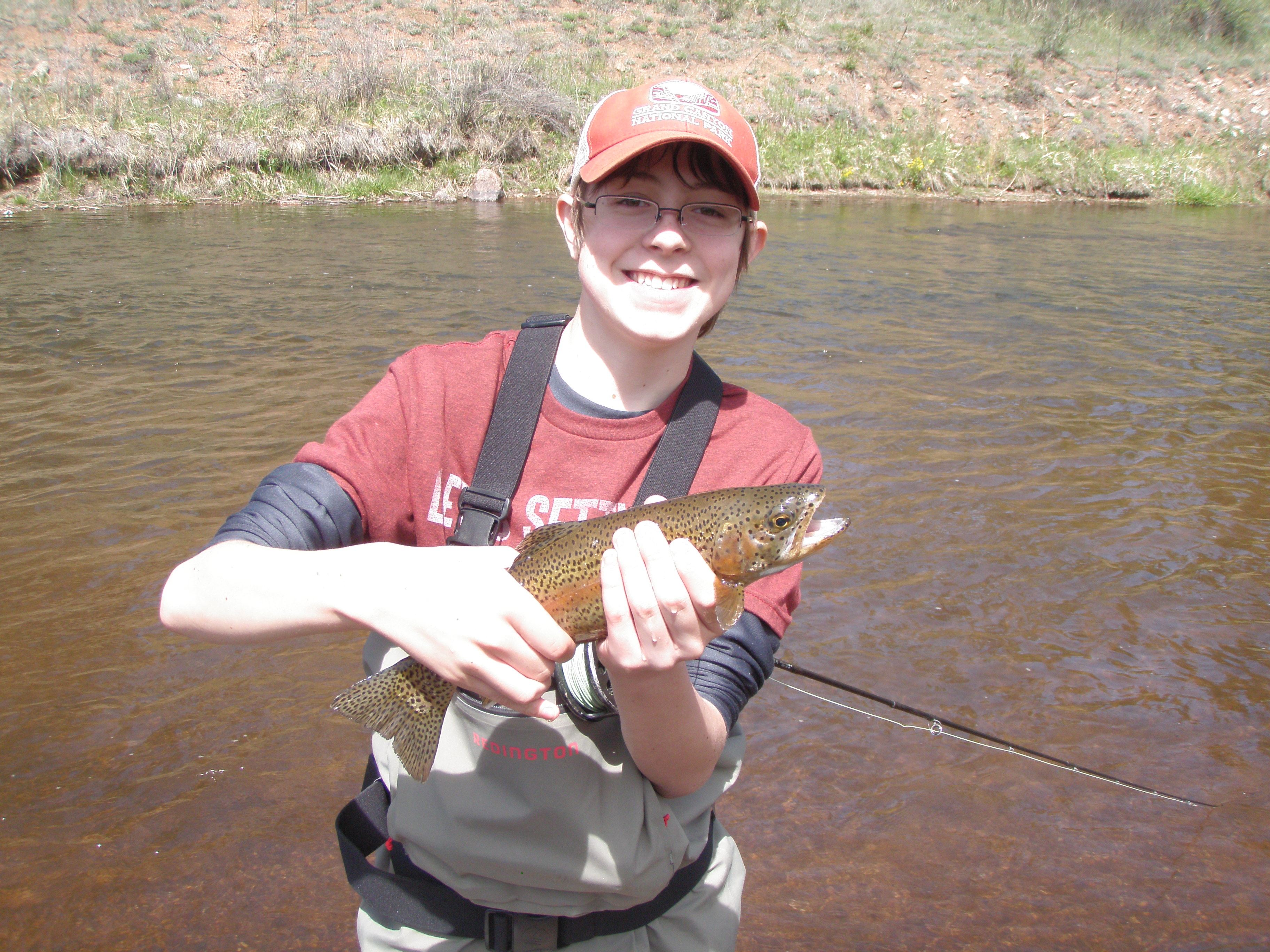
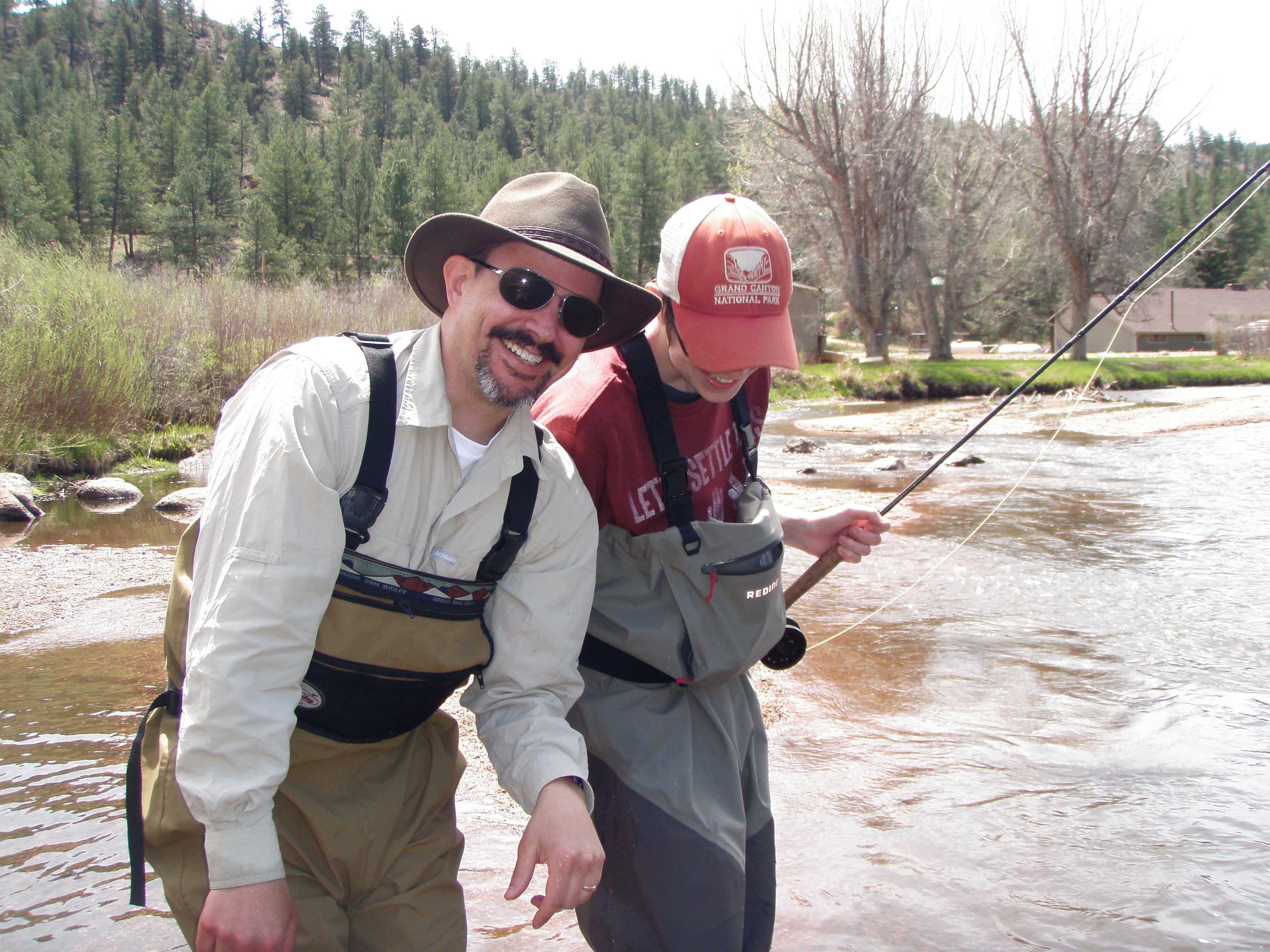
Nothing like the smile of a kid fly fishing with dad.
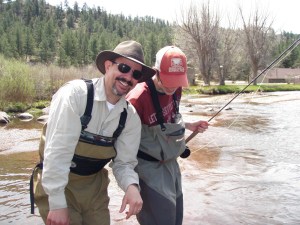
Dad and son all smiles even though the fish didn’t cooperate with the hero shot.
Hey Fellow flyfishers. Father’s Day is coming up and makes me think of the times I was able to fly fish with my dad. Some great memories were made, and the passion for chasing trout with a long stick was born.
It wasn’t just the fly fishing, it was the early morning departures, the sandwiches and chips riverside, and the wake-up when we would pull into the drive late. It was from Arizona to Montana and every state in between. Heck, we even belonged to the inaugural Tucson Fly Fishers Club. I consider myself very lucky to have been able to turn my passion into my work. It’s still my passion, and I tribute the flame from my dad.
Dad used to make me earn my own keep on the river or on the lake fly fishing from a canoe. I’d ask, “What’d you catch that on?”, and he would respond, “A good drift”. Or I’d say, “Where’d you catch it?”, to which he’d reply, “Right in the mouth.” I became much better, much faster, because my goal was to keep up with Pops. His instruction was subtle and complete.
I remember one time very vividly and fondly. We were fishing a stream in northern Arizona and were picking up a fish here and there. I noticed my dad stop and study a section of river, so I did the same. He then said we needed to head back to the camper and pull out the fly tying stuff. Once there, he proceeded to crank out several flying ant patterns. Obviously, once we hit that stretch, several fish were fooled and brought to net.
I love guiding father-son and father-daughter trips. I consider myself lucky to be a part of the memories being born. Raise a glass to all the dads out there, and pour a sip for those that have passed. Thanks Pops.

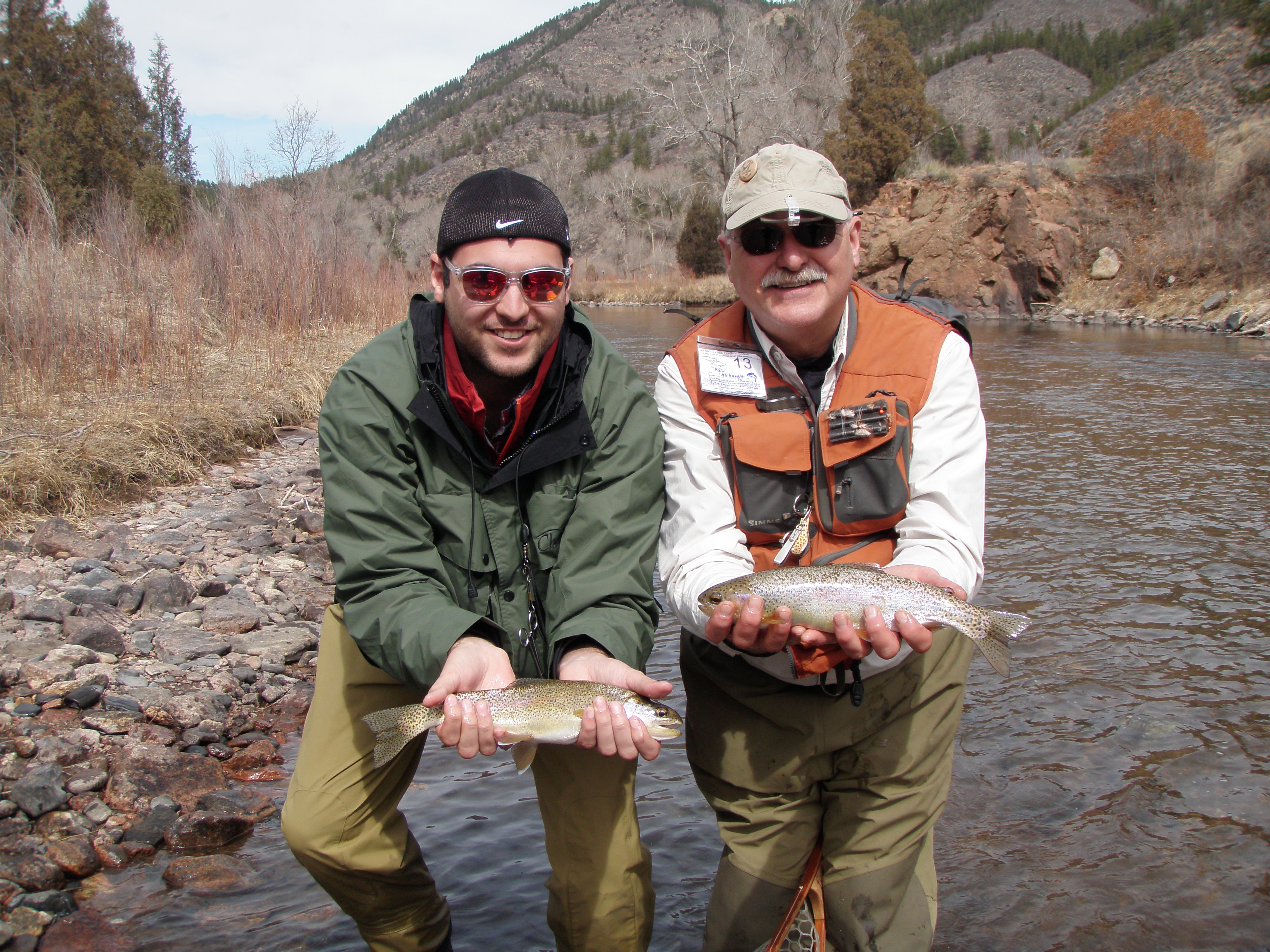
Father-son double.

Here’s a nice fish, her Dad took the picture.
Fear No Water and get a copy of The Fly Fisher’s Playbook for your favorite dad.
Duane

Hidy Ho good neighbors! Obstructions, obstructions, fish the obstructions. First off, what are obstructions, and secondly, how should I fish them?
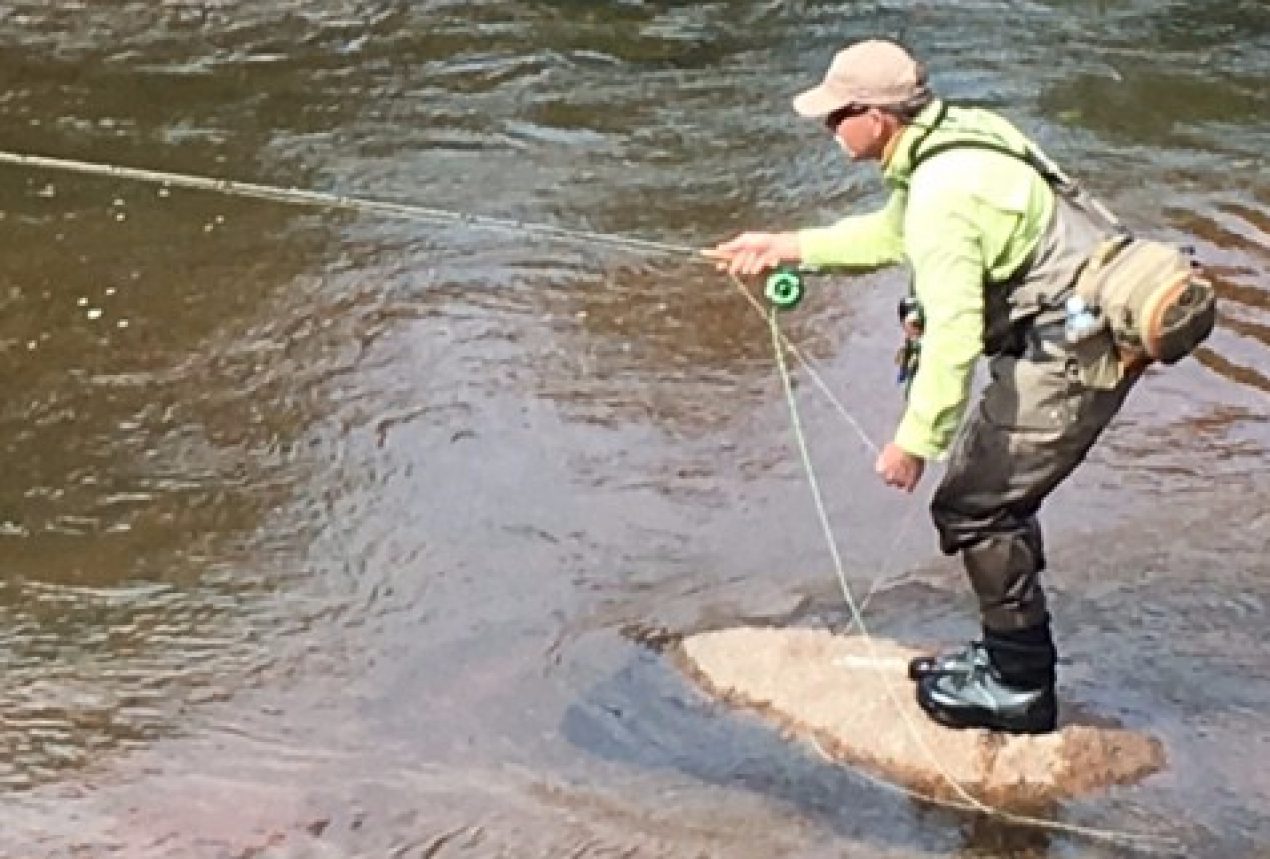
Looking at the picture above, gives a clear impression of what an obstruction is. To me, it’s any thing (or person, in this case) that affords a respite for fish from current in moving water. Be it natural, or man-made, it provides protection, safety, comfort, food, and sometimes additional oxygen. If an obstruction protrudes beyond the water surface, and the flow is strong, it can actually mix oxygen into the water.
So we have a cursory idea of obstructions. Now, how should we fish them? Countless times I’ll set a client in a run slot, and watch as the indicator bumps or stops in the same place drift after drift. The first couple of bumps and the angler usually will set, and typically after that I’ll hear, “There must be something down there I keep snagging on”. Exactly! It’s an obstruction! Use it to your advantage!
If you’re blind nymphing, meaning nymphing a run where you can’t spot fish, and can’t see bottom, then finding an obstruction is a gift from the fly fishing gods. We know that fish will sit in front, behind, or to either side of an obstruction according to river flow dynamics. Again, armed with this information, attack the obstruction. But how?
Move your feet. If you know where your bumping the obstuction, the amount of line you have out, and the general angle of your casts, then simply move your feet to change attack angles. A step back usually allows you to fish the near side of the obstruction. Stepping upstream with a quarter step in, usually gets you to the front of the obstruction. So forth and so on.
I harp all of the time about miniscule changes in positioning, and continue to this day to be amazed at the BIG differences caused by subtle position changes. I harp on this so much during trips that last week, a great guy named Bill was releasing a fish from his knees. After release, the trout slid tight downstream of him to sit in the soft water and recuperate. Bill looked up at me and said, “I am an obstruction”.
Fish those obstructions, buy The Flyfishers Playbook for Father’s Day, and Fear No Water!
Duane











 duaneredford.com