Archive for the ‘Uncategorized’ Category
Hidy, Ho good neighbors. Sitting here watching Braveheart and trying to get over whatever bug is kickin’ my tail. Hit me like a ton of bricks while on the water yesterday. Thankfully, I feel a bit better than then.
As promised, I am going to give you a link to a video dealing with long-line mending. I apologize beforehand for the audio. I used a tripod and camera in the river, and picked up a lot of water sound. Surprisingly, the times I viewed the video, I got used to it, and was able to fine tune the sound. You should too.
Couple of tips on mending:
- You can only mend what line you can take off the water.
- Mend to produce a drag free drift, I don’t care how you get drag free, just get there quickly with as little wasted line left as possible.
- Don’t try to over do it, move your feet closer before you try to over extend the drift and your capabilities.
- Learn specialty casts (reach, tuck, etc) to minimize mending.
- Learn to mend vertically.
- Mend like you’re mad at it……
View the video at: http://youtu.be/xtGOBORMFU4

Have a great week. Fear No Water!
Duane
I had the opportunity to visit quite a bit with Eric Stoup from Pennsylvania. Eric is a guide, author and speaker of high order. Eric and I spent a lot of time discussing nymphing techniques. He nymph fly fishes without an indicator. During our discussions I decided I would give his methods a try.
I always have felt that the more versatile a fly fisher you can be the better. So, armed with a leader that Eric designs and builds himself, a picture in my mind of how to rig bugs and weight, and a 9′ 5weight TFO, I hit the river.
Right away I realized how helpful an indicator is. So lost without it. I caught fish, some by accident, others on purpose, but an indicator for tailwater fish is a great tool. Tailwater fish have a tendency to take bugs gently. It was hard to detect a strike. I’m not saying Eric’s methods don’t work, on the contrary they do, but I’d have to log in many more hours to feel proficient. Funny, that’s the way I learned to nymph.
I think that the simple fact that I worked on that method for a half day, I became a better fly fisher. I had to really tighten up the drift, had to “feel” the fish, and had to be more attentive to everything. I certainly employ it again sometime, and I can envision it being a go-to method of nymphing on a few waters I fish like Clear Creek and the Middle Fork. It’s fun.
Eric’s method works. To learn how to employ it you can buy a copy of his first book, Common Sense Fly Fishing: 7 Simple Lessons to Catch More Trout.

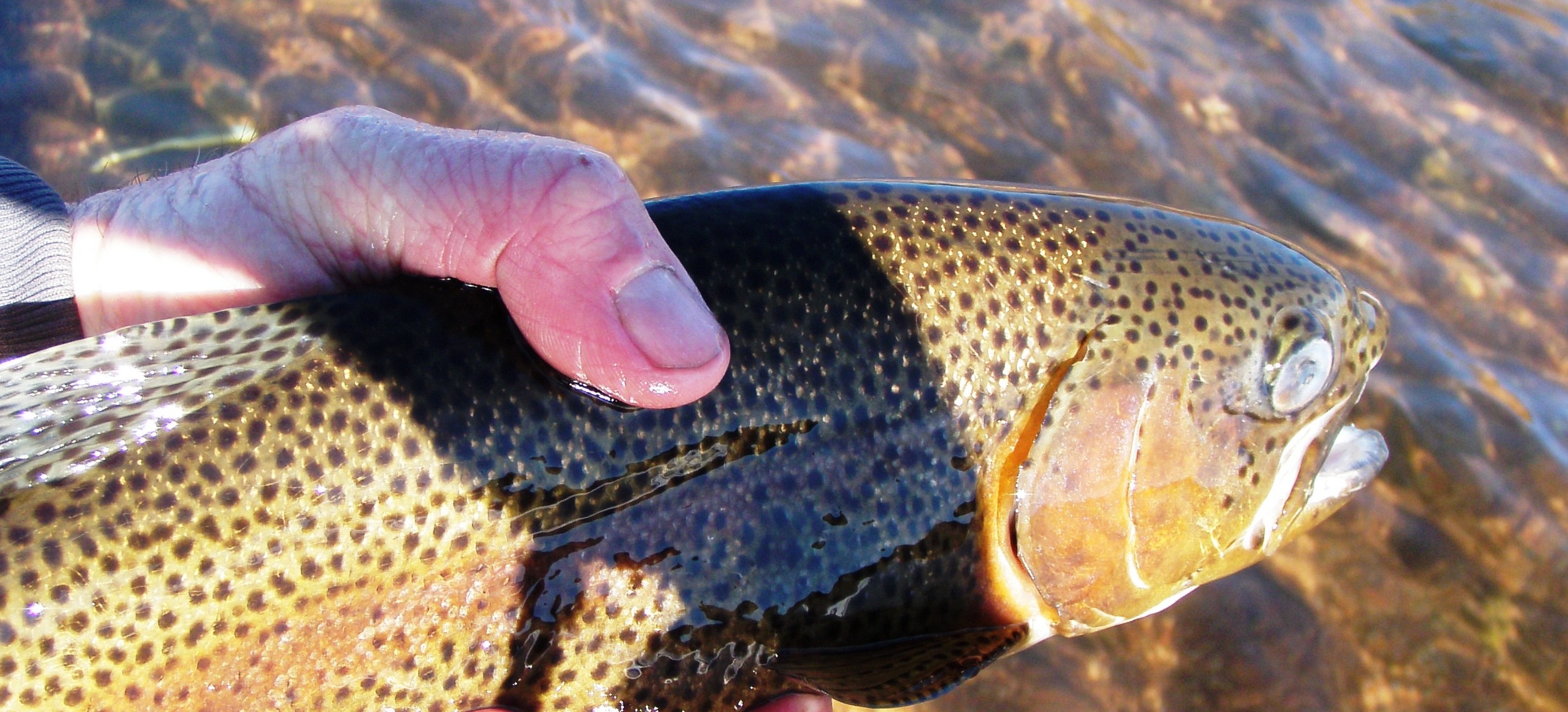
Pictured is a Cuttbow I picked up nymphing sans indicator. I “felt” this fish eat.
Stay tuned- next week I will post a video on long line mending.
Fear No Water!
Duane
Hidy ho, good neighbors. I had a great conversation with two fly fishers in the fly shop yesterday. Both had read my book, but wanted further clarification on the dimensions of the nymph drift.
I used to only think about the “horizonatal mend” during the drift. The mend that allows you to place line above, below, or a combination of both, of your fly line to get a drag free drift. By the way, I don’t like to use the term “dead drift”, I want those bugs to look “alive”, real. So, to achieve a “live” drift, the angler must either take line off the water, and/or mend the line to allow for minmal drag on the flies. Drag, simply put, happens when your flies are forced to go too fast or too slow and look unnatural to the fish.
Mastering the horizontal mend comes with time and attention to detail. As you become proficient you become to “see” the bugs in your mind’s eye. Don’t call me crazy, it’s true. You begin to have experience and expertise that allows you the chance to know exactly where your bugs are in the drift. However, and this is a big however, if you don’t realize the need for a vertical dimension within the drift, you will never really master the nymph drift.
If you took a cross section of the river and studied the dynamics of water speeds you would notice that the surface speed of the water is travelling roughly twice as fast as the water at your feet (grade). If you look at the diagram you will see what the forces are doing to your leader sub-surface. Yup, it’s creating drag. So, you could have your weight dialed in perfectly, but STILL be getting ugly drag on your bugs. The longer the drift, the more vertical drag you add to the drift. That’s why I employ the “pause mend”.
The pause mend is just that. Somewhere in mid drift, all you need to do is pause the indicator for just an instant. You will immediately see a difference in the drift. What happens is the paused indicator allows the leader to catch up to the drift, and you simply “release” it to finish the drift. Once you have it you will not only start picking off more fish, but you will become better at all facets of nymphing, especially sight nymphing. It’ in the Fly Fishers Playbook, it should be in yours!

Fear No Water!
Duane
I have already talked up sight fishing, but I continually harp on it because I think it’s the pinnacle of nymphing. It incorporates all of the facets, and bundles them up into a few (maybe one) good presentation(s).
Sight fishing allows your predatory nature to ooze. You can’t deny the instinct, it’s there. Some have a bit more mature instinct than others, but it’s there and it can be nurtured. Once you start walking the banks, while noting the sun and shadows, hunting for a solitary big fish, you’re well on your way to becoming an apex nymping predator!
I filmed a short blurb last week on the South Platte. Unfortunately, I didn’t set the shot up right so it’s not youtube worthy. I’ll post a link so you can view it later, but please allow me to list a few things to watch for in the video.
- Notice how I am set up
- Notice where I cast (distance and angle)
- Watch the set
The set-up is critical. Watch the sun angle, water depth and “chop”, and fish activity. The choppier the water, the better chance I have to get close to the fish, depth plays a role here too. Deeper water means easier fish to stalk, but it also means tougher sight nymping control. Experience is key. Why fish activity? The more active the fish, the less movement I can get away with, but I can get away with a poorer presentation. In other words, more active fish feed in a wider area, but tend to spook easier. The less active the fish (like the fish in the video) are easier to sneak up on, but your presentation has to be near perfect because inactive fish aren’t likely to move far side to side to eat.
I usually walk the elevated portions of banks to spot fish. After I spot one, I’ll reference a landmark, then sneak downstream to the waters edge. At this point I’ll strip out the line I think I’ll need, make any adjustments, and begin the stealthy stalk upstream with a low flat flyrod and line trailing downstream. Now, when I’m set, I’ll pick a spot upstream of the fish, and lay it in there. The distance I cast above the fish is determined (mostly) by water depth, water speed, my bugs weight, and the depth of the fish. Experience will teach you exactly where you need to cast if you use the same nymphing set-up to the point you know it well. Remember, you can move the flies to the desired line, depth, and speed if you happen to miss your mark. Go practice on a submerged rock. Really.
Fish to the fish. Usually, I see the fish eat. Look for side to side motion or “cotton”. “Cotton” is what you see when the fish opens it’s mouth to eat. Look at how I keep the fly rod tip downstream of the indicator. This helps me see what going on and reduces the time it takes to set on movement. This short of a drift doesn’t call for a mend, just high stick it. Keep your indicator in your peripheral view. When you watch the video, you’ll see it stop.
That’s enough for now. Here’s the link, I put it on the Flies and Lies Facebook. http://www.facebook.com/#!/Flies.and.Lies
Sight nymphing is great! Fear No Water,
Duane

Here’s the fish that is in the video……
Hey folks,
Here’s to 2013, may all your wishes come true.
I got to spend a bit of time on the river last week. Filmed two of the best guides on the South Platte River, Jeremy Hyatt and Jesse Bertsch. What a treat. Not only are they good friends and colleagues, these guys can flat out fish. Have to admit that I used their skills to define many key components of The Fly Fisher’s Playbook, but hey, that’s what friends are for!
To view about a three minute video clip, got to http://youtu.be/a1GYsG-zhlk
Keys to look for include, body position, roll cast presentations, the speed of the indicators, fly rod positioning, the set, and anything else you can skim from the video.
Hey, I’m going to be signing books at the Denver Fly Fishing Show this weekend. Here’s my schedule that I’m in the Authors Booth:
Friday, Jan 6th @ 11:00am
Saturday, Jan 7th @ 9:00 am
Sunday, Jan 8th @ 2:00pm
Stop by and say “hey”. Fear No Water, Duane
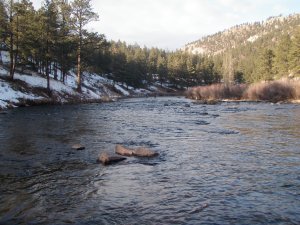


It’s all about smiles, joy, peace. I am blessed with smiles everyday I am on the water. Lot’s of folks have graced the lens of my camera with stunning smiles. It’s not really about the fish, it’s about the time spent on the water (peace) and time spent with friends. I’m just lucky to be a part of it.
I don’t take it for granted. Nope, I try to soak in every second. Surviving prostate cancer will do that to you. Every sunset is a little more colorful, lasts a bit longer, and lingers on my mind til the next one. Yup, I’m blessed.
Here’s to you being blessed as well. Enjoy every season!
Fear No water,
Duane
I figure I might as well finish the job and talk some more about how to read the river. If you haven’t already, take a look at a 5 minute video I loaded on youtube: http://youtu.be/pDsCsIb0ycM It’s pretty basic, but I think it shows the foundation of river reading. You have to find the fish, and find out what they’re eating. It’s that basic, but that important. Reading the river is the first step in finding fish.
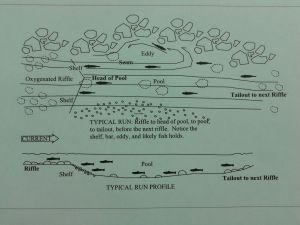
The picture above illustrates how and where fish hold in the different parts of a run, couple this with why they are there, and you’re mostly done. Obviously, what’s left is what they’re eating and at what stage is the insect of choice. That’s what I call reverse entomology and it’s for another time.
The fishes nose is pointing to where he was stationed in the run. He was in the seam that forms the shelf below the riffle. He ate a black midge pupa.
This fish is pointing to where he was fooled by a Pat’s Rubberleg. He was sitting in the uppper section of the tailout. See the riffle downstream?
Please feel free to ask questions, comment, and share this info.
Another good source for this information, and it is in much more depth, is the Fly Fishers’ Playbook. I think you can still order one and have it for Christmas!
Fear No Water!
Duane
A fair amount of people ask me how to “read the water” when I am out speaking. The first thing I tell them is that we need to be speaking the same language. By that, I am simply talking about how I define a run. To me, a run is a section of the river that has a riffle, to a shelf, to a pool, to a tailout. There can be several runs in one section of the river depending on how wide it is. When I am on wide rivers I will divide the river horizontally to create 3 rivers (left, center, right). Each horizontal section can have various runs.
A run can be long or short but always ends when the tailout meets the next riffle. It’s there, you’ll find it. So let’s break this down a bit more. Riffles can , in my mind, be up to 3 feet deep, sometimes deeper. It just depends on the substraight and how it flows into the pool section. Look for a shelf between the riffle and the pool section, that will help determine the riffle section. Riffles are magnets to feeding and spawning fish. Riffles typically force fish to make a quick decision as to feed or not, because of water speeds. Riffles force fish into danger and hard work. Riffles are your friend.
The shelf sections after riffles are very productive. Fish lean on the safety and calmness of the shelf to pick off tons of bugs dislodged in the riffle above. Plenty of prime lies in this section for sure. The trick with a shelf is to place your flies high enough on the shelf to hit the right depth as you drift over it without snagging the riffle itself. In other words, you want your flies to present at the proper depth as you flow onto and over the shelf.
The pool is a place where you will find fewer feeding fish. This is typically a “safe” lie area, or what I call the “pouting” area. I see a lot of fish we hook in the riffle and the shelf end up pouting in the deeper calm of the pool. On occasion we’ve hooked fish in the pool, but I don’t waste much time on them if they aren’t actively feeding. Keep an eye on them because if you witness a fish swim upstream from the pool to the shelf, it’s game on!
Next is the tailout. I see a bunch of people disregard the tailouts. Either they don’t recognize it, or they don’t have much luck there. I will specifically target tailouts at certain times of the day. We hook some of our biggest fish in tailouts. As the bottom of the river starts to incline back up to the next riffle, the water compresses to create a bug bonanza. I find fish , some of the bigger ones at that, will move into a tailout to eat spent dries or key on emergers on the swing. That’s why you have to hit them at the right times.
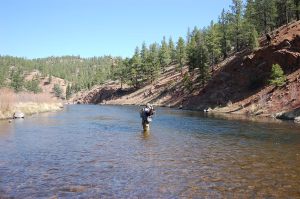
If you look carefully, you can see I am working the shelf between the riffle and the pool.
It’s all in The Playbook!
Fear No Water!
Duane
 I had the honor to guide two absolutely great people this past week. John and Fred. These are the kind of folks that after we spend time on the river, we become friends. Just good people. Pictured to the left is the first fish Fred has caught with a fly rod. Made it look easy. This fish ate a stone fly nymph imitation (size 12 Pat’s Rubberleg). Yup, that’s good news, means the flows have come up, and fish food is being knocked about. Nice feeesh!

Here’s Fred with another fish and John to the left. John and I have fished together before. He is a decent stick and a dang nice dude.
Let me remind everyone to fish through the entire drift, from the initial stage through the swing stage. I swear, if done properly, you should pick up about a third of your fish on the swing. Fish it all the way and position set at the end. If you need more explanation, feel free to comment.
Gotta be slated for some snow someday….Soon I hope!
Happy Holidays, and remember, the Fly Fishers Playbook will fit neatly into any fly fishers’ stocking!
Til next week,
Fear No Water!
Made a video today down on the South Platte. I took about seven minutes to talk about tips and techniques used to land fish on a fly rod. I honestly think it’s easier for beginners and intermediate anglers to hook fish than land them.
Hope the video proves helpful: http://youtu.be/uthTlo3yWUw
Couple other items: 1. If you haven’t already, be sure to read my new article in my last post. 2. Tis the season to buy stuff for the fly fisher you know. May I suggest The Fly Fishers’ Playbook?
Thanks,
Duane


 duaneredford.com