Archive for the ‘“flyfishersplaybook’ Tag

Hidy Ho good neighbors! Obstructions, obstructions, fish the obstructions. First off, what are obstructions, and secondly, how should I fish them?
Looking at the picture above, gives a clear impression of what an obstruction is. To me, it’s any thing (or person, in this case) that affords a respite for fish from current in moving water. Be it natural, or man-made, it provides protection, safety, comfort, food, and sometimes additional oxygen. If an obstruction protrudes beyond the water surface, and the flow is strong, it can actually mix oxygen into the water.
So we have a cursory idea of obstructions. Now, how should we fish them? Countless times I’ll set a client in a run slot, and watch as the indicator bumps or stops in the same place drift after drift. The first couple of bumps and the angler usually will set, and typically after that I’ll hear, “There must be something down there I keep snagging on”. Exactly! It’s an obstruction! Use it to your advantage!
If you’re blind nymphing, meaning nymphing a run where you can’t spot fish, and can’t see bottom, then finding an obstruction is a gift from the fly fishing gods. We know that fish will sit in front, behind, or to either side of an obstruction according to river flow dynamics. Again, armed with this information, attack the obstruction. But how?
Move your feet. If you know where your bumping the obstuction, the amount of line you have out, and the general angle of your casts, then simply move your feet to change attack angles. A step back usually allows you to fish the near side of the obstruction. Stepping upstream with a quarter step in, usually gets you to the front of the obstruction. So forth and so on.
I harp all of the time about miniscule changes in positioning, and continue to this day to be amazed at the BIG differences caused by subtle position changes. I harp on this so much during trips that last week, a great guy named Bill was releasing a fish from his knees. After release, the trout slid tight downstream of him to sit in the soft water and recuperate. Bill looked up at me and said, “I am an obstruction”.
Fish those obstructions, buy The Flyfishers Playbook for Father’s Day, and Fear No Water!
Duane
Hidy ho good flyfishers.
A River Runs Through It was a great movie, no doubt. It did wonderful marketing and spurred the fly fishing industry. Fantastic acting, scenery, and of course the epic fly casting. Ah, the fly casting. Proved to be the strike point or brand of the film. However, I think it has scared away many would be fly fishers.
I have folks come into the fly shop and tell me that they would love to learn to fly fish but aren’t capable of the rod handling that they saw in the movie. Had a nice lady ask me last year if she should book back to back days on the water, because she figured we would work the entire first day on casting. My clients today said I better think about just tying on one fly (instead of three) because they aren’t capable of casting three fly rigs. I told them that if you can say “three bug rig” you can certainly cast it.
I admire good casting skills as much as the next dude, but all an nymph angler needs is the ability to utilize a water loaded roll cast. Stick your elbow in the slot, get your thumb as high as your hat, pick a spot, and put your thumb on it. It really is that simple, and I find folks pick it up rapidly. And yup, you guessed it, the minute you roll cast you are officially fly fishing. I have a video or two on youtube dealing with casting. They are easy to find, if you want a refresher. Just type my name and youtube for a search.
The South Platte is fishing great. Blue Wings are coming off any time of the day depending on conditions, and the fish are on them. Trips have been very productive nymphing in the morning and looking for noses to cast dry flies and dry-drops to in the late morning, early afternoon. Pheasant tails and baetis emergers are the ticket.
I am busy working on a new technique, nothing earth shattering, but it works. I’m having clients utilize it in certain conditions, and it is proving to be effective and fun. Think I’ll keep R&Ding it and maybe include it in my next book. Time will tell.
Probably going to post every other week, because I’m getting very busy. If something happens that just needs to be shared, I’ll certainly post it. Please feel free to contact me, and comment. Until then, Fear No Water! Duane
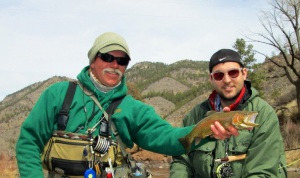
During the winter, I’m not on the water as much as when the season is ripping. That being said, when I do have gaps between trips, it sometimes feels as if I am guiding on “new” water.
About a month ago I guided on a stretch of water that I hadn’t laid eyes on in two years. To say I was a bit aprehensive would be more than accurate. But, over the years I’ve learned a few tricks that ease the pain and usually gets us into fish in a reasonable time frame.
First off, no matter the size of the river, learn to break it down into “runs” in longitudinal sections. River left, river middle, and river right. I learned that reading Bill Edringtons’ book about the Arkansas River. This will help you manage the river and your emotions. Just pick it apart from down-to-up and in-to-out. By this, I mean to pick one run in one section, and fish it up river from near to far.
Fish to your strengths. I’m fairly adequate at nymph fishing, so I am absolutely going to dial in depth and speed. You can catch fish with the wrong bugs at perfect depth and speed. Once I do a bit of reverse-engineering, or recognizing adult bugs and working back to the nymph stage, I should be picking up increasing numbers of fish because of the right fly choices. If you’re good and confident at throwing streamers, dry-drops, or whatever, use it to your advantage to pick up fish while you learn more about the river.
Apply what you know. For example, if you know how, where, and why fish set-up around an obstruction or in a bend, then concentrate on that water. If you’re proficient in riffles, then find and fish them. What you know breeds confidence and allows you to systematically attack the river. No guesses, only the next option. Enjoy the experience.
Make sure you can identify caddis, mayflies, midges, and stone flies. Learn their stages, and simple flies that mimic them.
Last and certainly not least, employ fish spotting skills. I am a much better guide and fly fisher when I can see fish. No big mystery there, but good polarized optics and the accompanying skills are paramount.
Just a few thoughts on using old tricks on a new river. Try it sometime and Fear No Water!
Duane

Hey Folks,
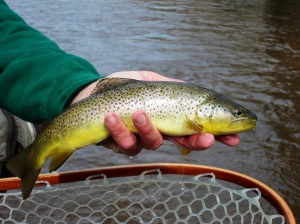
Here’s a bow we hooked last week on a Pat’s Rubber Leg. The Stone Fly nymphs are molting, and the fish are on them.
Last week I was priveledged to speak to another Trout Unlimited Chapter. The Cheyenne Mountain Chapter out of Colorado Springs is a very innovative and energetic group. I look forward to tracking their progress.
Next week, the 14th, I will be speaking to the Greenback Chapter of TU in Pueblo. Road trip! It is very humbling to stand in front of hard working, dedicated folks, and talk fly fishing. My presentation deals with the restoration of Horse Creek, all the factors that negatively effect the Platte, and how to overcome them. The ol South Platte is hard enough to guide day in and day out, but you factor in how Horse Creek impacts it, and you are staring a super finicky beast in the kisser.
That’s how The Fly Fishers Playbook was born. It took a solid 5 years to develop the Playbook, and truth be told, it’s still evolving. The Playbook was basically written before I ever hit a key. I kept a journal for every minute I spent on that river. After a couple years I began to see that I could systematically progress thru options to get to fish. In other words, I stopped guessing as to what to do next, and began to filter thru the next best method to attack the river. It was a blast to write.
Why am I writing about this? I started writing the book 2 years ago March 5th, so I’m feeling a bit nostalgic. Also, the book has opened several doors. I’ve met some fantastic people presenting, doing book signings, podcasts, and of course on the river.
I’m really considering beginning another book. I’ve an outline cooking, but need to work out some details. In the meantime, I’ll continue to speak to whatever group that will have me.
Thanks for listening to my ramblings. Here’s another picture as payment….

Fear No Water,
Duane
Hidy, Ho good neighbors. Sitting here watching Braveheart and trying to get over whatever bug is kickin’ my tail. Hit me like a ton of bricks while on the water yesterday. Thankfully, I feel a bit better than then.
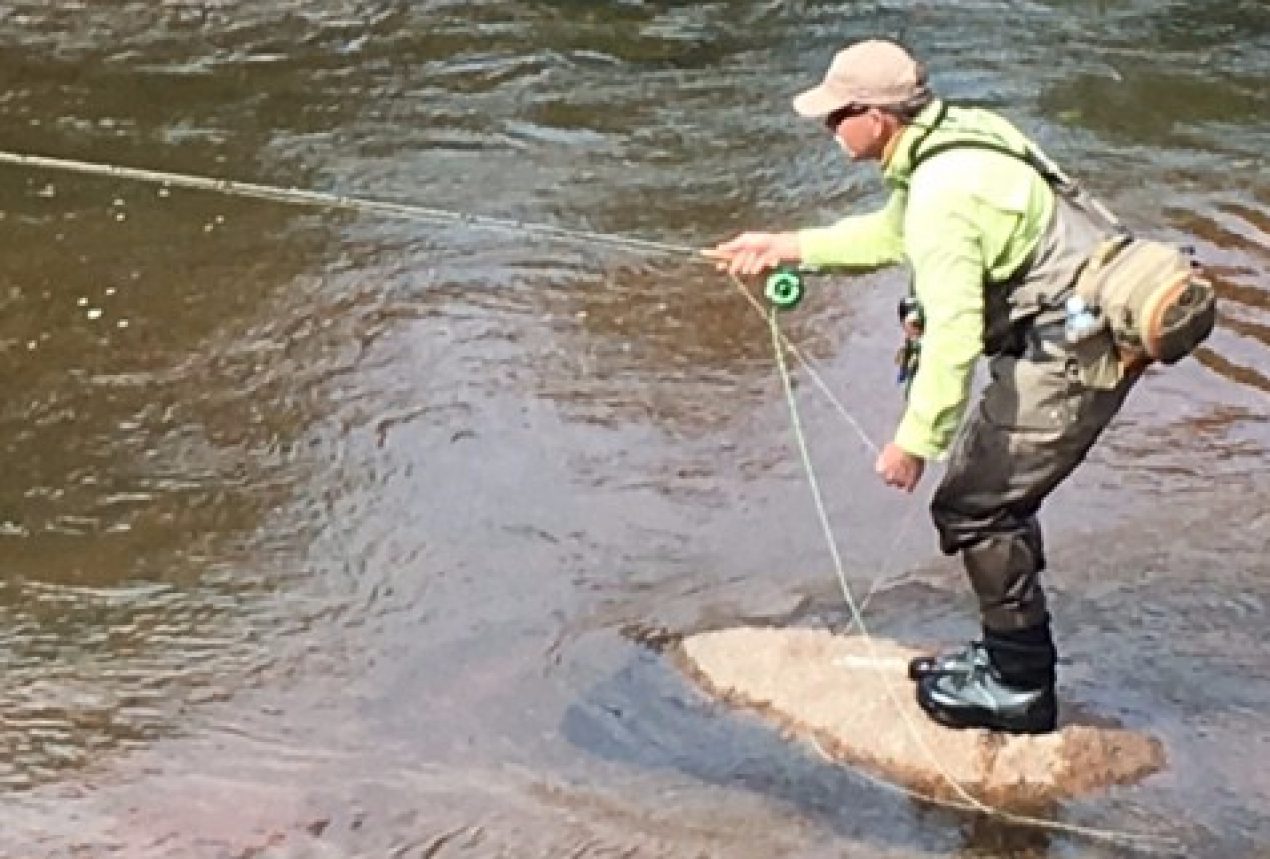
As promised, I am going to give you a link to a video dealing with long-line mending. I apologize beforehand for the audio. I used a tripod and camera in the river, and picked up a lot of water sound. Surprisingly, the times I viewed the video, I got used to it, and was able to fine tune the sound. You should too.
Couple of tips on mending:
- You can only mend what line you can take off the water.
- Mend to produce a drag free drift, I don’t care how you get drag free, just get there quickly with as little wasted line left as possible.
- Don’t try to over do it, move your feet closer before you try to over extend the drift and your capabilities.
- Learn specialty casts (reach, tuck, etc) to minimize mending.
- Learn to mend vertically.
- Mend like you’re mad at it……
View the video at: http://youtu.be/xtGOBORMFU4

Have a great week. Fear No Water!
Duane


 duaneredford.com