Archive for the ‘South Platte’ Tag
Hidy, Ho good neighbors. Sitting here watching Braveheart and trying to get over whatever bug is kickin’ my tail. Hit me like a ton of bricks while on the water yesterday. Thankfully, I feel a bit better than then.
As promised, I am going to give you a link to a video dealing with long-line mending. I apologize beforehand for the audio. I used a tripod and camera in the river, and picked up a lot of water sound. Surprisingly, the times I viewed the video, I got used to it, and was able to fine tune the sound. You should too.
Couple of tips on mending:
- You can only mend what line you can take off the water.
- Mend to produce a drag free drift, I don’t care how you get drag free, just get there quickly with as little wasted line left as possible.
- Don’t try to over do it, move your feet closer before you try to over extend the drift and your capabilities.
- Learn specialty casts (reach, tuck, etc) to minimize mending.
- Learn to mend vertically.
- Mend like you’re mad at it……
View the video at: http://youtu.be/xtGOBORMFU4

Have a great week. Fear No Water!
Duane
I had the opportunity to visit quite a bit with Eric Stoup from Pennsylvania. Eric is a guide, author and speaker of high order. Eric and I spent a lot of time discussing nymphing techniques. He nymph fly fishes without an indicator. During our discussions I decided I would give his methods a try.
I always have felt that the more versatile a fly fisher you can be the better. So, armed with a leader that Eric designs and builds himself, a picture in my mind of how to rig bugs and weight, and a 9′ 5weight TFO, I hit the river.
Right away I realized how helpful an indicator is. So lost without it. I caught fish, some by accident, others on purpose, but an indicator for tailwater fish is a great tool. Tailwater fish have a tendency to take bugs gently. It was hard to detect a strike. I’m not saying Eric’s methods don’t work, on the contrary they do, but I’d have to log in many more hours to feel proficient. Funny, that’s the way I learned to nymph.
I think that the simple fact that I worked on that method for a half day, I became a better fly fisher. I had to really tighten up the drift, had to “feel” the fish, and had to be more attentive to everything. I certainly employ it again sometime, and I can envision it being a go-to method of nymphing on a few waters I fish like Clear Creek and the Middle Fork. It’s fun.
Eric’s method works. To learn how to employ it you can buy a copy of his first book, Common Sense Fly Fishing: 7 Simple Lessons to Catch More Trout.

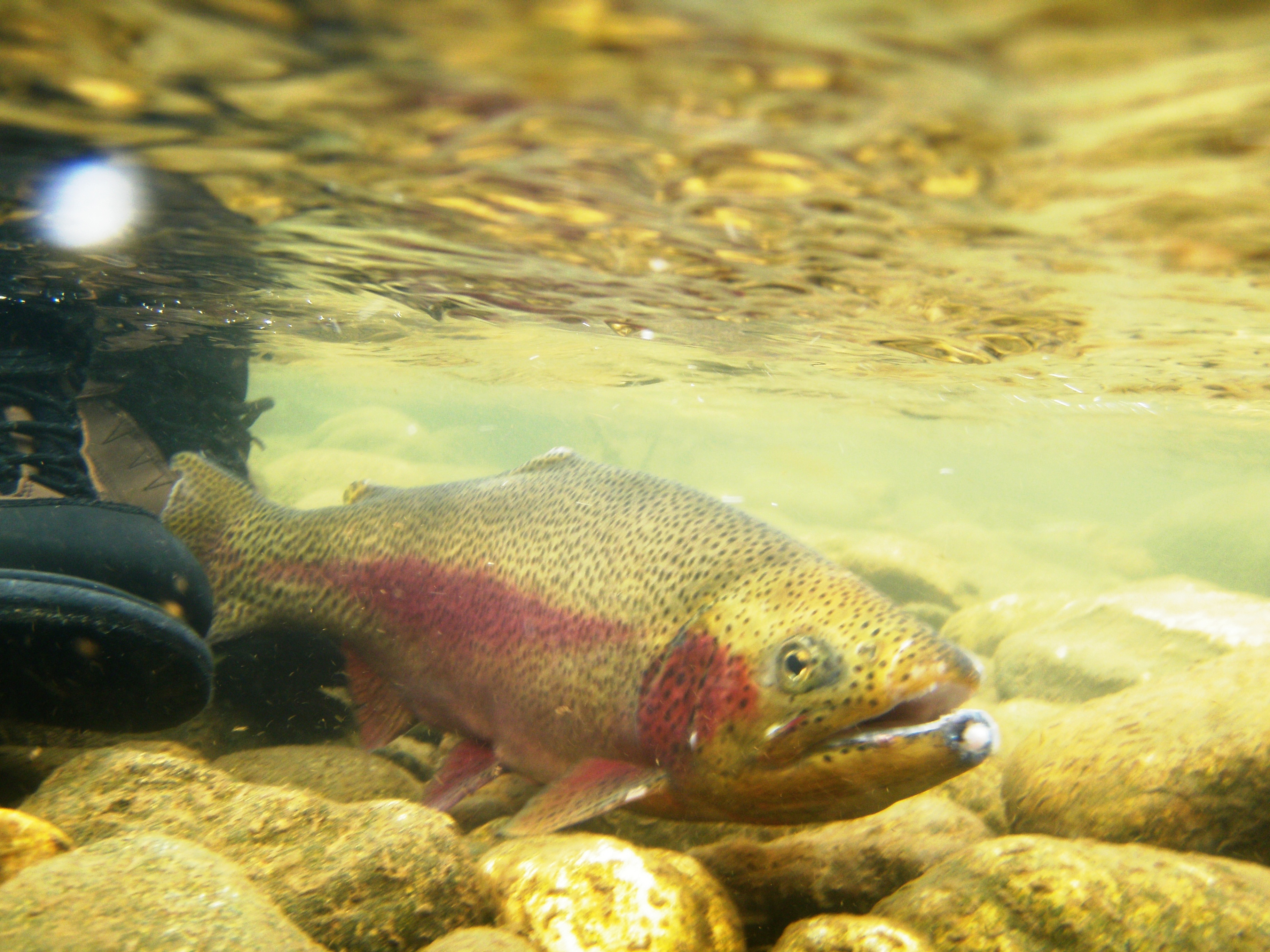
Pictured is a Cuttbow I picked up nymphing sans indicator. I “felt” this fish eat.
Stay tuned- next week I will post a video on long line mending.
Fear No Water!
Duane
Hidy ho, good neighbors. I had a great conversation with two fly fishers in the fly shop yesterday. Both had read my book, but wanted further clarification on the dimensions of the nymph drift.
I used to only think about the “horizonatal mend” during the drift. The mend that allows you to place line above, below, or a combination of both, of your fly line to get a drag free drift. By the way, I don’t like to use the term “dead drift”, I want those bugs to look “alive”, real. So, to achieve a “live” drift, the angler must either take line off the water, and/or mend the line to allow for minmal drag on the flies. Drag, simply put, happens when your flies are forced to go too fast or too slow and look unnatural to the fish.
Mastering the horizontal mend comes with time and attention to detail. As you become proficient you become to “see” the bugs in your mind’s eye. Don’t call me crazy, it’s true. You begin to have experience and expertise that allows you the chance to know exactly where your bugs are in the drift. However, and this is a big however, if you don’t realize the need for a vertical dimension within the drift, you will never really master the nymph drift.
If you took a cross section of the river and studied the dynamics of water speeds you would notice that the surface speed of the water is travelling roughly twice as fast as the water at your feet (grade). If you look at the diagram you will see what the forces are doing to your leader sub-surface. Yup, it’s creating drag. So, you could have your weight dialed in perfectly, but STILL be getting ugly drag on your bugs. The longer the drift, the more vertical drag you add to the drift. That’s why I employ the “pause mend”.
The pause mend is just that. Somewhere in mid drift, all you need to do is pause the indicator for just an instant. You will immediately see a difference in the drift. What happens is the paused indicator allows the leader to catch up to the drift, and you simply “release” it to finish the drift. Once you have it you will not only start picking off more fish, but you will become better at all facets of nymphing, especially sight nymphing. It’ in the Fly Fishers Playbook, it should be in yours!

Fear No Water!
Duane


It’s all about smiles, joy, peace. I am blessed with smiles everyday I am on the water. Lot’s of folks have graced the lens of my camera with stunning smiles. It’s not really about the fish, it’s about the time spent on the water (peace) and time spent with friends. I’m just lucky to be a part of it.
I don’t take it for granted. Nope, I try to soak in every second. Surviving prostate cancer will do that to you. Every sunset is a little more colorful, lasts a bit longer, and lingers on my mind til the next one. Yup, I’m blessed.
Here’s to you being blessed as well. Enjoy every season!
Fear No water,
Duane
I figure I might as well finish the job and talk some more about how to read the river. If you haven’t already, take a look at a 5 minute video I loaded on youtube: http://youtu.be/pDsCsIb0ycM It’s pretty basic, but I think it shows the foundation of river reading. You have to find the fish, and find out what they’re eating. It’s that basic, but that important. Reading the river is the first step in finding fish.
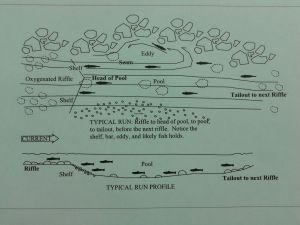
The picture above illustrates how and where fish hold in the different parts of a run, couple this with why they are there, and you’re mostly done. Obviously, what’s left is what they’re eating and at what stage is the insect of choice. That’s what I call reverse entomology and it’s for another time.
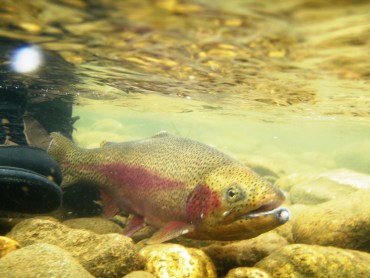
The fishes nose is pointing to where he was stationed in the run. He was in the seam that forms the shelf below the riffle. He ate a black midge pupa.
This fish is pointing to where he was fooled by a Pat’s Rubberleg. He was sitting in the uppper section of the tailout. See the riffle downstream?
Please feel free to ask questions, comment, and share this info.
Another good source for this information, and it is in much more depth, is the Fly Fishers’ Playbook. I think you can still order one and have it for Christmas!
Fear No Water!
Duane
A fair amount of people ask me how to “read the water” when I am out speaking. The first thing I tell them is that we need to be speaking the same language. By that, I am simply talking about how I define a run. To me, a run is a section of the river that has a riffle, to a shelf, to a pool, to a tailout. There can be several runs in one section of the river depending on how wide it is. When I am on wide rivers I will divide the river horizontally to create 3 rivers (left, center, right). Each horizontal section can have various runs.
A run can be long or short but always ends when the tailout meets the next riffle. It’s there, you’ll find it. So let’s break this down a bit more. Riffles can , in my mind, be up to 3 feet deep, sometimes deeper. It just depends on the substraight and how it flows into the pool section. Look for a shelf between the riffle and the pool section, that will help determine the riffle section. Riffles are magnets to feeding and spawning fish. Riffles typically force fish to make a quick decision as to feed or not, because of water speeds. Riffles force fish into danger and hard work. Riffles are your friend.
The shelf sections after riffles are very productive. Fish lean on the safety and calmness of the shelf to pick off tons of bugs dislodged in the riffle above. Plenty of prime lies in this section for sure. The trick with a shelf is to place your flies high enough on the shelf to hit the right depth as you drift over it without snagging the riffle itself. In other words, you want your flies to present at the proper depth as you flow onto and over the shelf.
The pool is a place where you will find fewer feeding fish. This is typically a “safe” lie area, or what I call the “pouting” area. I see a lot of fish we hook in the riffle and the shelf end up pouting in the deeper calm of the pool. On occasion we’ve hooked fish in the pool, but I don’t waste much time on them if they aren’t actively feeding. Keep an eye on them because if you witness a fish swim upstream from the pool to the shelf, it’s game on!
Next is the tailout. I see a bunch of people disregard the tailouts. Either they don’t recognize it, or they don’t have much luck there. I will specifically target tailouts at certain times of the day. We hook some of our biggest fish in tailouts. As the bottom of the river starts to incline back up to the next riffle, the water compresses to create a bug bonanza. I find fish , some of the bigger ones at that, will move into a tailout to eat spent dries or key on emergers on the swing. That’s why you have to hit them at the right times.
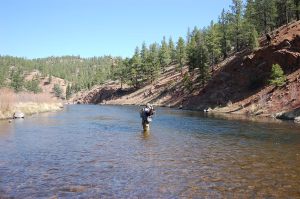
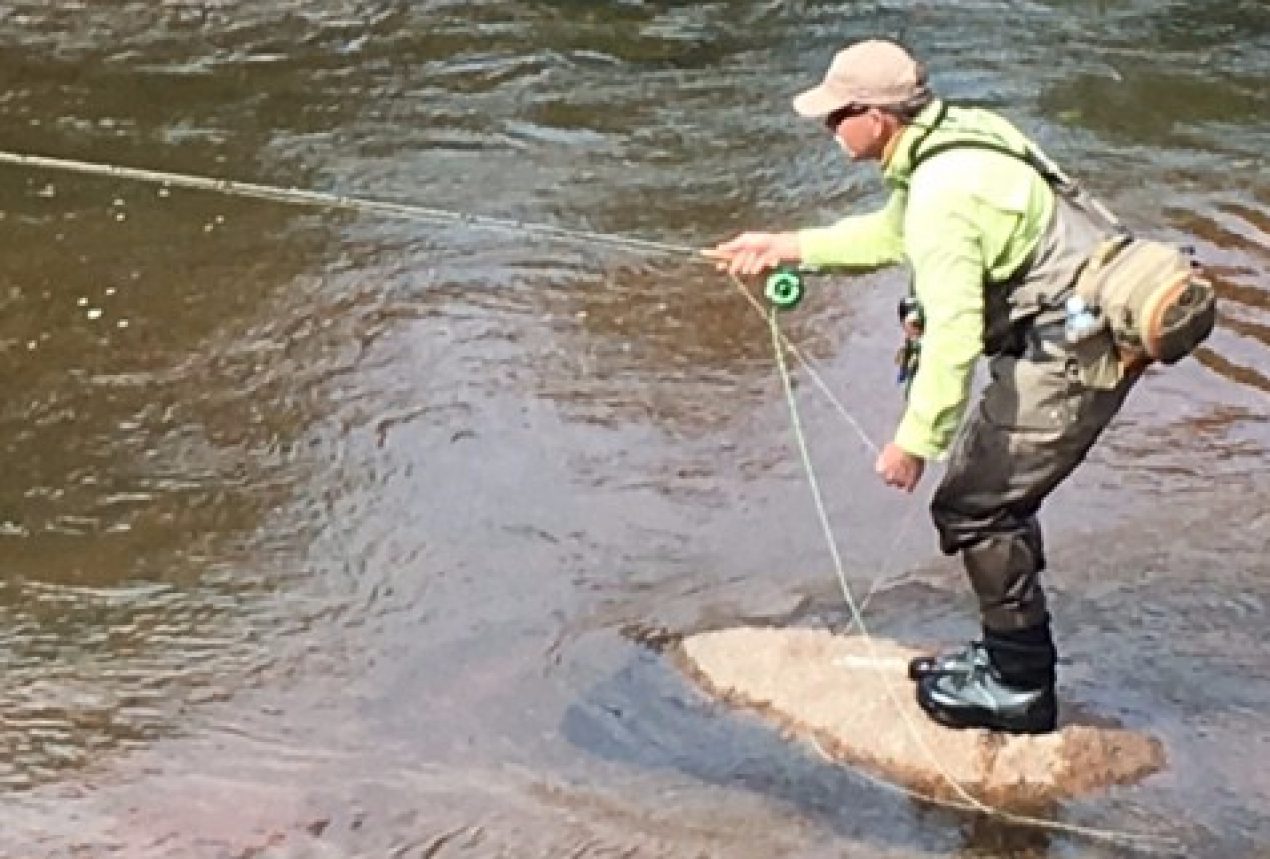
If you look carefully, you can see I am working the shelf between the riffle and the pool.
It’s all in The Playbook!
Fear No Water!
Duane
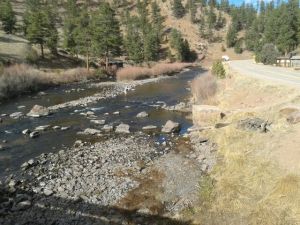 Although it’s not historically supported, low flows are not uncommon in the winter months on freestones and tailwaters alike. It’s a fact of life, although it’s not always desireable or easy to fish. You just have to employ a different mind-set.
I still fish 3 bug nymph rigs, but I will use lighter tippets (6x), smaller, bugs, and smaller indicators. My distances between bugs diminishes because the water columns typically consolodate. Bugs that are usually separated by 12″ are now drifting about 8″ apart. Indicators are still yarn, but are trimmed to a low profile and are not as thick as before.
When you locate fish in shallow water, it’s not a bad idea to scoot your indicator further up the line, or take it off altogether if the fish is unusually spooky. Most times I’ll fish to those fish with a typical set-up, but I really focus on the set-up and fly rod flash, in an attempt to not bust fish. Keep drifts short on sighted fish to really control your presentation. Fish to the fish. Meaning set on fish movement or if you see “cotton” or the white of the fishes mouth opening.
Your thermometer is a great tool this time of year. Water temps really drive the fish feeding, so getting a good handle on your particular waters feeding temps is important. Document that stuff, it’ll pay dividends later.
It’s a great time of year to fish. get out and cover water, sight fish, and enjoy the great outdoors.
Happy Thanksgiving!

I fished with Bob from Texas this week. What a great guy. We were walking in the river when we both noticed a 2 strand hunk of wire sticking out. We began to pull on it and noticed that it crossed the entire river. At that point, not wanting to shorten his day, I told him I would come back for it. He wasn’t going to have any of that as he quickly stashed his fly rod and began to dislodge the wire. After 15 or 20 minutes, we had the entire length of wire out of the river and stashed on the far bank.
Thanks Bob for being such a great steward of one of Colorado’s gems.
Be looking next week for some more videos!!!!
D



 duaneredford.com