Archive for the ‘Uncategorized’ Category
Happy Black Friday folks! I’ve decided to celebrate by writing an article I plan to submit to a certain website. I’ll let you know details later. It looks like I’m going to fish and film tomorrow. Hope to post this weekend, stay tuned.

Here’s the article, feel free to respond!
“Crocodile Tears and Snot Bubbles”
I showed up at the fly shop bright and early, looking forward to a fun day on the river. The gentlemen I was slated to guide had arrived a day early, spent the night in one of the cabins that the fly shop rents, and had fished quite a bit the day prior. Now, this can be a blessing or a curse as a guide, because the finicky tailwater I guide can turn on or off without warning. After introductions and handshakes all around, I set to rigging their rods.
Noticing right off, that they had the proper flies already rigged up under an indicator, I asked how the river fished the day before. I was told that there were “crocodile tears and snot bubbles” per fly fisher. They hadn’t caught a fish. Whoever at the fly shop sold them the flies had done his job by leading them in the right direction, as the bugs they were running were the same ones I planned to throw this day. Why in the heck did they not hook up?
I guide by the notion that “if you change nothing, nothing changes”, and judging by the flies they had rigged, I was able to quickly throw that out of the equation. The reason they were skunked the day before, lousy drifts aside, had to be a function of depth and speed. When I am nymph fly fishing I live by the depth, speed, profile and color formula. Those four factors play a huge role in my success as I guide or fish. Remember, depth, speed, profile and color.
Once to the river’s edge, I quickly went over the tenants of a good nymph drift, and we spread out to work the run. Noticing right off that these guys could manage a decent nymph drift, made it clear that depth and speed were the culprits of yesterday’s poor outing. Over the years, it has become apparent that you can throw the right bugs at improper depths and speeds and have a tough day on the river. Conversely, you can throw the wrong bugs at proper depths and speeds, and still manage a few. I adjusted the depth and speeds of both rigs, and we immediately began to move fish.
The rule of thumb for depth is to have your distance from your weight to your indicator at one and one half times the depth of the run your fishing. I take it a step further and insure the weight is ticking the bottom from the top of mid-drift through the swing for my particular nymph rig. My particular nymph rig consists of, in descending order, the indicator to the weight, to the two or three flies (see the Fly Fishers Playbook). Again, the key to the depth is to make darn sure the weight is ticking bottom throughout the majority of the drift.
Depth is depth, weight is speed. Once you have the depth dialed in, you can then dial in the speed. Speed is simply controlled by weight. More weight equals more drag, which equals slower speed. I like to get my indicator moving at half the speed of the surface water. Because of the nature of flowing water, the water at your feet is moving roughly half the speed of the water at the surface due to drag caused by the atmosphere. Pick out a leaf, stick or bubble, and fiddle with the weight until your indicator slows to the proper speed. I like to have a split shot above the leader to tippet connection, and micro-manage the weight with a tungsten putty to really dial it in. I refer to this as slowing down the game.
So now I have the depth and speed dialed. Next is to dial in the profile of the bugs that I am trying to match. You have to discern what they prevalent bugs are where you’re fishing and go from there. I’m lucky, I get to be on the water a ton, so I usually know what’s coming off and I work backwards from there. On this day the bugs that were going to pop where caddis and blue wing olives, so I simply did a bit of reverse-engineering. Soft-hackled pheasant tails, and blue wing emergers were the flies I chose to run under the indicators. Those bugs, at the proper sizes, were precisely what were on the menu. Couple this with the right speed and depth, and you’re dangerous.
Once you have depth, speed, and profile locked in, you should be moving fish. If you have one of those days where the fish are looking for all of the above AND colors, then you’re going to have to really get technical. Honestly, it’s not terribly often where specific color plays a large role in catching fish, but it does happen. There have been days when the fish will readily eat a blue midge larva over a red one, but thankfully, that is not the norm at least where I guide. If you are sure your depth, speed, and profile are perfect, and you’re still not hooking up, look to decrease profile sizes and change fly color.
We fished the same flies all day, never changed anything but depth and speed, and had a wonderful time. This systematic approach works. The next time you’re on the river, try to employ this approach, it’s a safeguard against “crocodile tears and snot bubbles”!
Duane Redford guides out of Flies and Lies in Deckers, Colorado, on the famous South Platte River. He is the author of The Fly Fisher’s Playbook, A Systematic Approach to Nymph Fly Fishing.
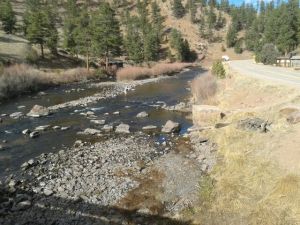 Although it’s not historically supported, low flows are not uncommon in the winter months on freestones and tailwaters alike. It’s a fact of life, although it’s not always desireable or easy to fish. You just have to employ a different mind-set.
I still fish 3 bug nymph rigs, but I will use lighter tippets (6x), smaller, bugs, and smaller indicators. My distances between bugs diminishes because the water columns typically consolodate. Bugs that are usually separated by 12″ are now drifting about 8″ apart. Indicators are still yarn, but are trimmed to a low profile and are not as thick as before.
When you locate fish in shallow water, it’s not a bad idea to scoot your indicator further up the line, or take it off altogether if the fish is unusually spooky. Most times I’ll fish to those fish with a typical set-up, but I really focus on the set-up and fly rod flash, in an attempt to not bust fish. Keep drifts short on sighted fish to really control your presentation. Fish to the fish. Meaning set on fish movement or if you see “cotton” or the white of the fishes mouth opening.
Your thermometer is a great tool this time of year. Water temps really drive the fish feeding, so getting a good handle on your particular waters feeding temps is important. Document that stuff, it’ll pay dividends later.
It’s a great time of year to fish. get out and cover water, sight fish, and enjoy the great outdoors.
Happy Thanksgiving!

 Winter holds what? Winter holds for trout. As the water gets skinny, every trout has to move to winter holding spots to survive. Look for deeper cuts of river downstream of an oxygenated riffle. Or, better yet, look for fish. Get some good polarized optics, and work on your fish spotting skills.
On the South Platte we are still seeing baetis, or Blue Wings. Not as prolific as before, but still lurking. Don’t be caught without the ability to change rigs quickly when you see them start to pop.
You gotta fish like a ninja from here til basically run-off, so you might as well start working on fish spotting and sight nymphing. Sight nymphing is the epitome of nymphing. Have to find the fish, sneak in, present bugs, and set on movement. Fish to the fish. Great fun. If you haven’t already, look at a short video at http://www.youtube.com/watch?v=WO37uE9eR_E&feature=plcp
I would like to hear some feedback on my podcast. The link to listen in is www.askaflyfishingguide.com Pass it around to your friends!
Have a great week folks, you never know what WINTER HOLDS!
Duane
What a great time of the year! The weather is really holding and the fish are carrying the colors of fall.
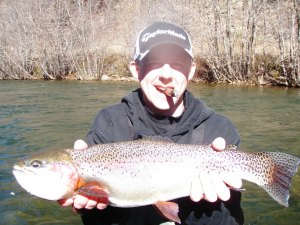
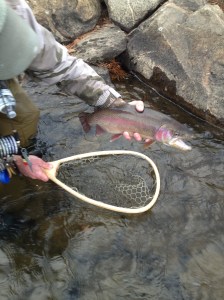 The rainbow on the left ate a brown leech pattern behind an egg. Guess it figured it would eat the ham first. Picking up a bunch of fish using that technique. Just put the leech about 4″ below the egg under an indicator.
Here’s Pat with a super fish picked up on the North Fork.
 Not a bad fish. Pat really tore ’em up. Couldn’t have happened to a nicer guy. I believe this fish ate a leech as well.
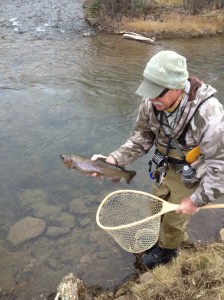
No doubt you need to layer up to fish this time of year, but the rewards can be fantastic.
If you get a chance listen to my 2 part radio podcast at www.askaflyfishingguide.com
Fear No Water!
Duane
 Yea, yea, I know. This time of year is so much fun for me. I get to bowhunt Nebraska and the guiding season for pheasants is cranking up. Haven’t forgotten about fly fishing, just other things to do. I will continue to try to update every Monday through the winter. I’ve got a couple fly fishing trips booked in between pheasant hunts coming up.
The South platte is still fishing great. Tricos have all but diminished til next year, but we are seeing a tiny baetis (about 22), and the fish are on them. It’s fun to try to pick up fish on tiny bugs on the surface. Use full length leaders (minimum 8′)smaller tippets (6x), set up properly so you don’t spook fish with your fly rod “flash” or fly line, and work your way into the fish. Depending on the set-up you can quarter downstream approach, cross stream approach, or you can upstream approach. Each situation is different. Be cautious and try to figure it out. Experience is the best teacher here. Remember, “If you ain’t catchin’, you should be learnin”.
I am taping a national podcast this week on www.askaflyfishingguide.com Will let you know when my podcast becomes available. In the meantime, Fear No water!
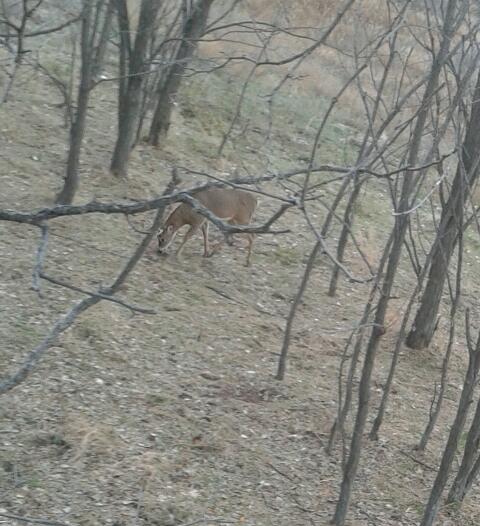
p.s. Pictured are Blue the pheasant-finding-machine, and a small buck that fed under my stand…….
 Had a lot of fun on and off the river this week. Met a bunch of nice folks, caught some fish, and completely enjoyed this late October weather.
On Tuesday and Wednesday evenings I was lucky enough to present to two prominent fly fishing groups. Absolutely fantastic groups with great questions.
Guided on public and private waters, and was blessed with some excellent fishing. Fall fly fishing can be incredible, and this week was no exception. We caught fish on dries, nymphs and dry droppers. Good stuff.
Fear No Water,
Duane


Happy October.
Did a bit of fishing this morning and decided to produce a quick video dealing with some main components of the drift. Pretty basic stuff, but critical as a building block to more complicated techniques.
You can find the video at: http://www.youtube.com/watch?v=MKc5zSe5xOg&feature=youtu.be
Also, over the years I’ve seen some incredible stuff while on the river. Today was no exception…….
 Tricorythodes….That insect name can strike fear into the heart of any fly fisher. The “Trico” is a small mayfly that has the distinction of being one of the toughest to catch fish. It is frustratingly beautiful to fly fish during this hatch. So many bugs, fish that are dialed in to one particular stage, and precise casts and drifts make this a very solid challenge. You master this and you are a great fly fisher.
The Tricos or Trikes are coming off in hoards on the South Platte in Deckers. The males (black body) typically hatch in the late evening or at night. The little gray females hatch in the mornings and join the mating swarms to mate and fall spent. What you have are thousands of dead bugs floating spent on the surface. The fish love it, anglers not so much.
You gotta’ read the rise. Typically, early in the hatch you can pick up a few fish on the surface throwing a gray bodied dry fly that mimics the female dun. You will see smaller fish producing splashy rises on the surface chasing the emergers and duns, you can bring a few to net with a well drifted matching dry. I usually, depending on the skill of the angler, opt to throw a rig under an indicator that consists of a small pheasant tail, a gray or black RSII, and a still born or drowned trico pattern. Concentrate on the swing portion of your nymph drift.
As the hatch cranks up and you begin to see fish slurping on the surface, this is where you earn your keep. You’ll notice that most of the fish are situated in one slot and rarely move more than a few inches left or right to eat. You’ll also notice that feeding fish have a cadence. You can time them. Your job is to present a dead bug, in one slot, on time. It isn’t easy, but it’s a blast!
I like to lengthen my leader a bit, down to 6x tippet, but I try to not make it so long that it becomes a detriment for my angler to manage. When these fish get to guzzling, it seems you can dance on their heads without spooking them, so I like about an 8 ½ foot leader. At the end of that leader I will tie a single dry fly. You can get away with a double dry rig, but I have found a single rig to be much more effective because 2 bug dry rigs tend to multiply the drag and turn away fish. Find a guzzler, line it up, time it up, and start working.
In any particular slot you may find a dozen gulping fish. Break down the slot, fish the back portion first and work your way forward. Too many folks try to fish the entire slot, in my opinion; you’re wasting your time, because a long the drift is nearly impossible to control. Instead, find a feeding fish at the end of the slot and work 3-4 feet in front of it to a couple feet below it. Shorten the distance of your cast above the fish if the fish is eating in a fast cadence. You may not be able to see your fly so if you think you’re close, and the fish eats, set.
Speaking of the set, try to “lift” on the set against the direction the fish is facing. Throwing 6x tippet after doing some nymphing earlier is a recipe for a set that is too forceful. I always warn my guests about this, but we typically manage to snap the first fish off on the set……
Find yourself a good trico hatch, and go have some fun. Remember, Fear No Water!
Also, A HUGE thank you to Kirk Deeter for a great review of my book in TU’s Trout Magazine!
Duane
I am posting a quick video on how to build a yarn indicator for nymphing. A bunch of you have already seen this, but I hope others get to view it.
Go to http://youtu.be/Zt9OVq0Gzbk
Nice cool weather today. Makes me want to be on the river. I took a moment to upload a video on how I set up a 3 bug nymph rig.
The key to any nymph rig is the ability to make quick changes to accomodate the conditions.
Hope you enjoy: http://youtu.be/6K5Cgd6_K9Q







 duaneredford.com